US President Donald Trump has refused to rule out further military action against Iran after the November 3 midterm elections, as reports indicate that Washington and Israel may be preparing for another major campaign against Tehran.
According to The Wall Street Journal (WSJ), the United States has warned several Gulf Arab countries to prepare for a possible short, intense military campaign aimed at weakening Iran and pushing it towards negotiations.
The reported preparations come as diplomatic efforts to end the conflict remain stalled, tensions over the Strait of Hormuz continue, and Washington reiterates that preventing Iran from acquiring nuclear weapons remains a priority.
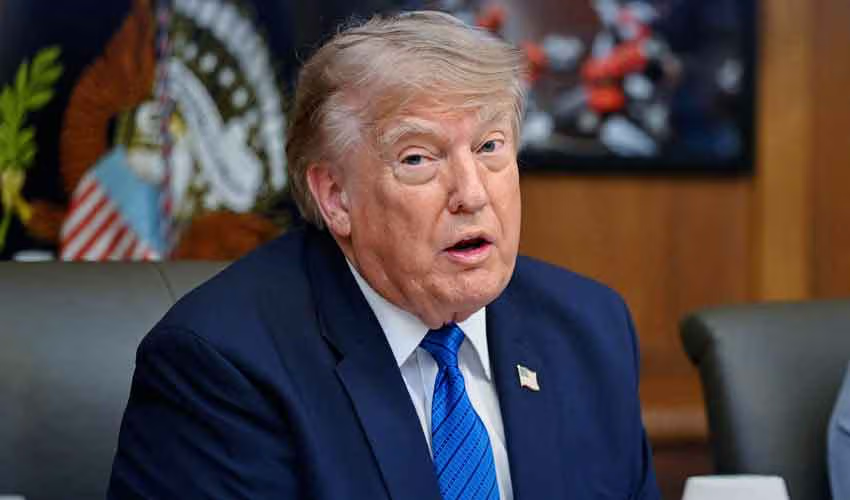
Speaking at a campaign rally in Lubbock, Texas, Trump said he could not confirm whether the United States would launch further attacks after the elections.
“Anything is possible, including further military action against Iran,” he said, describing Washington as being in an “extremely strong position” in its dealings with Tehran.
Trump claimed Iran wanted an agreement but was deliberately delaying negotiations. He suggested Iranian leaders might be waiting for the US elections, warning that such a strategy would not benefit Tehran.
Tariq Fazal Chaudhry Defends KP Security Measures, Says Rs160bn Grant Approved
The president said the decision to end the conflict rested with him, leaving open the possibility of renewed military action.
US and Israel reportedly prepare for renewed strikes
The Wall Street Journal reported that diplomatic and military communications with several Gulf Arab countries had added to indications of possible renewed US-Israeli operations against Iran.
According to people briefed on the discussions, the Pentagon was repositioning forces, strengthening regional air defences and replenishing ammunition supplies ahead of a possible offensive.
The reported preparations included moving a Patriot air-defence battery from Texas to the Middle East, relocating personnel away from bases considered vulnerable to Iranian retaliation, and preparing US bombers and fighter jets for potential strikes.
The report also said an additional aircraft carrier strike group and a Marine expeditionary unit were expected to join approximately 20 US warships in the region the following month.
Trump has not publicly confirmed a final decision to authorise a large-scale attack. The reported military options include strikes on Iranian energy infrastructure, nuclear facilities, and missile and drone capabilities.
The White House declined to comment on what it described as “sensitive military plans that may or may not exist”.
“President Trump keeps all options on the table to ensure that Iran can never have a nuclear weapon,” the White House said.
Trump claims Iran’s military capabilities have been weakened
At the Texas rally, Trump portrayed the US military campaign as a major success, claiming American forces had severely damaged Iran’s military capabilities and economy.
He also alleged that Iran’s inflation rate had reached 301% in recent days. That figure was not independently established in the material provided.
Trump referred to Operation Midnight Hammer and Operation Epic Fury, claiming US forces had destroyed Iran’s nuclear enrichment capacity and inflicted substantial military and financial damage.
“We obliterated Iran’s nuclear enrichment capacity with Operation Midnight Hammer and Operation Epic Fury and defeated them militarily, financially and otherwise,” he said.
“It could be over whenever I wanted it to be over,” Trump added.
Iran has repeatedly denied that it intends to develop nuclear weapons, while Washington maintains that preventing Tehran from acquiring them remains a central objective.
Strait of Hormuz remains a major point of contention
Trump also claimed the United States had complete control over the Strait of Hormuz, a strategic waterway crucial to international oil and gas shipments.
“We have complete control over the Strait of Hormuz; I would call it the ‘Strait of Trump’,” he said.
The strait has remained a central issue in the confrontation between Washington and Tehran. Disruptions to shipping through the waterway have raised concerns about global energy supplies, maritime security and potential increases in oil and gas prices.
The reported scale of the disruption has heightened concerns among energy-importing countries. Approximately one-quarter of global oil trade and around one-fifth of global liquefied natural gas trade pass through the Strait of Hormuz, according to the figures cited in the supplied report.
Any renewed fighting that further restricts navigation could have significant consequences for international shipping and energy markets.
Regional security concerns intensify
The reported military preparations come amid heightened security concerns across the Middle East.
According to the report, the United States has reinforced its regional military posture and ordered nonessential diplomatic personnel and family members to leave Saudi Arabia, while reducing staffing at several other regional embassies.
Iran has warned that renewed US-Israeli attacks would trigger retaliation beyond American military positions. Tehran has threatened regional energy facilities, airports, pipelines and other infrastructure, raising concerns that another campaign could widen the conflict.
Any escalation could expose military installations, commercial shipping routes and critical infrastructure across the Gulf to further risks.
Diplomatic efforts remain stalled
The prospect of renewed attacks comes as negotiations have failed to produce a lasting settlement.
Iran has resisted US demands for concessions on its nuclear programme, while Washington has continued to apply pressure through sanctions, maritime restrictions and threats of further military action.
According to the timeline outlined in the supplied report, the United States and Israel launched their war against Iran on February 28. Tehran responded with missile and drone attacks across the region, while the Strait of Hormuz became a major flashpoint.
A memorandum of understanding was reportedly signed in June to establish a path towards a final peace agreement and an immediate cessation of hostilities across multiple fronts, including Lebanon. However, disagreements over its terms, particularly navigation through the Strait of Hormuz, prevented a lasting settlement.
The report also states that Washington resumed large-scale strikes on the night of July 8, accusing Tehran of violating understandings concerning the strait. The US administration subsequently signalled a shift towards tighter economic pressure and sanctions.
These details, including the reported military movements and potential offensive plans, have not been independently verified here. The White House has not confirmed that a new offensive has been authorised.
Post-election period could prove critical
With Trump keeping military options open, diplomatic efforts stalled and regional forces reportedly preparing for possible escalation, the period following the November 3 midterm elections could prove significant for the conflict.
A renewed US-Israeli campaign could intensify pressure on Iran but also increase risks to regional security, energy infrastructure and international shipping.
For now, the central uncertainty remains whether Washington will authorise further strikes or pursue additional negotiations to reach a settlement.