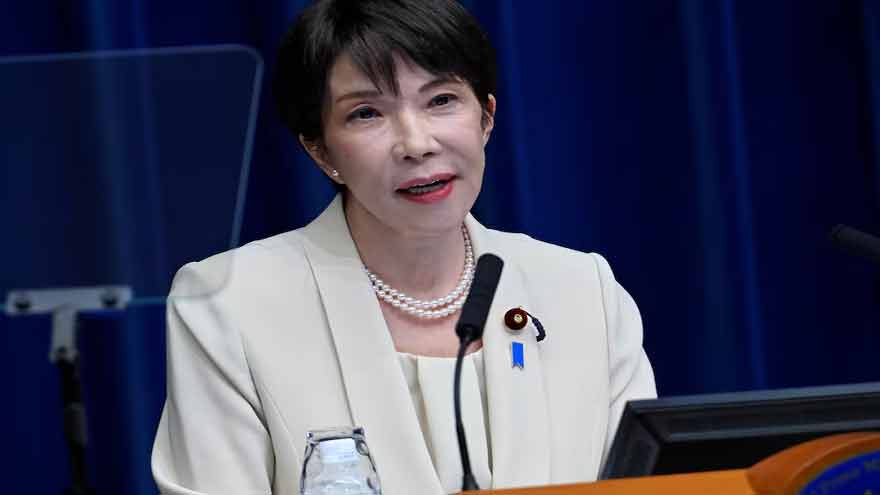
Takaichi kept reflationist ally Minoru Kiuchi as economy minister. The decision suggests she intends to maintain her flagship spending plans.
Kiuchi said he would pursue both economic growth and fiscal sustainability after the new cabinet lineup was announced.
“We won’t engage in wanton fiscal expansion,” he said. He also pledged to address market concerns over the government’s economic policies.
Takaichi’s approach has faced criticism because Japan carries the highest public debt burden among advanced economies. Her plan for a two-year tax cut on food products recently contributed to a bond selloff and drew criticism from the United States.
Finance Minister Retains Key Role
Takaichi also retained Finance Minister Satsuki Katayama in her first cabinet reshuffle since taking office last October.
Katayama, a former Finance Ministry bureaucrat, is viewed as more cautious on fiscal policy. Her continued appointment could reassure bond investors concerned about increased government spending and additional debt issuance.
Keiji Kanda, a senior economist at the Daiwa Institute of Research, said markets had become increasingly sensitive to fiscal risks.
He said stable long-term interest rates were becoming important for Japan’s economic growth. He also linked Katayama’s reappointment to Takaichi’s efforts to maintain policy continuity.
Trump Says Iran War May Be Nearing an End as Yemen Front Widens
Katayama played a key role in negotiations with US Treasury Secretary Scott Bessent over a rare joint US-Japan yen intervention in late July. Her reappointment signals continuity in Japan’s foreign exchange policy.
Key Ministers Stay in Their Posts
Other senior ministers also retained their positions. They include Foreign Minister Toshimitsu Motegi and Defence Minister Shinjiro Koizumi, who were among Takaichi’s rivals in last year’s ruling party leadership contest.
The reshuffle also sought to give the Japan Innovation Party a greater role in policymaking. The party is a coalition partner of Takaichi’s Liberal Democratic Party.
Takaichi appointed Hiroshi Nakatsuka of the Japan Innovation Party as minister responsible for deregulation.
Eight of the cabinet’s 18 ministerial posts went to existing ministers. They included Trade Minister Ryosei Akazawa, who oversees Japan’s trade negotiations with the United States.
Government Faces Fiscal Balancing Act
Japan’s benchmark 10-year government bond yield reached a three-decade high this week. Investors remain concerned that higher government spending could further increase public debt.
Japan’s public debt is roughly twice the size of its economy, giving the government limited room to expand spending without facing greater market pressure.
At the same time, households continue to face higher living costs. Takaichi could therefore face domestic pressure to maintain her promises to cut taxes and increase spending.
Her pledge to keep new government bond issuance near 40 trillion yen ($256 billion) for the fiscal 2027 budget is already under scrutiny. Budget requests have risen to levels last seen during the pandemic.
Japan may also increase defence spending as the government reviews its national security strategy this year.
Bank of Japan Decision in Focus
The cost of servicing Japan’s debt is rising as the Bank of Japan increases interest rates and reduces its bond purchases.
The central bank has been gradually moving away from decades of large-scale monetary stimulus.
The Bank of Japan is widely expected to raise its key policy rate by 25 basis points to 1.25% on Friday, adding another challenge for the government as it seeks to balance economic support with fiscal stability.
Exchange rate: $1 = 156.1700 yen.