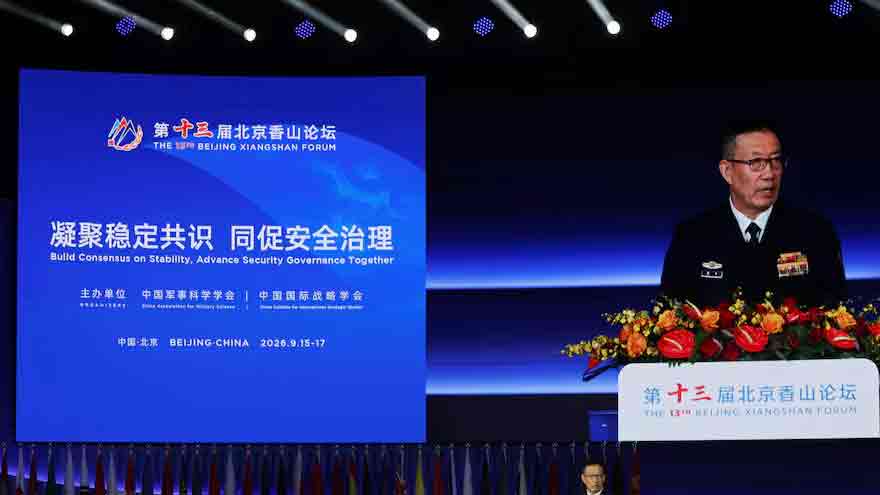
Chinese Defence Minister Dong Jun has urged countries to avoid provocative actions and prevent the return of what he described as regressive historical trends, in remarks widely seen as an indirect warning to Japan.
Speaking at the Beijing Xiangshan Forum on Wednesday, Dong said the world had entered a “fragile moment” as regional tensions increase over Taiwan and the disputed South China Sea, while questions persist over the future of US security commitments in Asia.
In his opening speech, Dong called for a more equal approach to addressing international disputes and warned against what he described as manifestations of hegemony, militarism and historical revisionism.
“We must bear in mind the lessons of history,” Dong said, urging countries to remain vigilant against actions that could revive past conflicts and create new risks.
His comments come amid strained relations between China and Japan. Beijing has repeatedly criticised Japan after Prime Minister Sanae Takaichi suggested that a hypothetical Chinese attack on Taiwan could prompt a Japanese military response.
Supreme Court Seeks Guidance on Constitutional Court’s Role in Imran Khan Case
China has accused Japan of moving towards its militarist past, pointing to Japan’s occupation of Manchuria in 1931 and the subsequent war between Japan and China.
Around 2,000 military officers, diplomats and academics from 100 countries are attending the three-day Beijing Xiangshan Forum, which concludes on Thursday. Participants include regional defence officials, a senior Pentagon representative, Russian academics and representatives of Afghanistan’s Taliban administration.
Dong avoided directly criticising the United States or regional allies such as Japan, instead reiterating Beijing’s longstanding position in favour of a peaceful and multipolar international order.
He called for a global system based on “partnership rather than alliance” and “win-win rather than zero sum”, while warning against provocative actions that could serve the interests of individual countries or groups at the expense of wider regional stability.
The remarks come ahead of an expected meeting between Chinese President Xi Jinping and US President Donald Trump in the United States next week.
China claims Taiwan as part of its territory and has increased military pressure around the self-governed island, including periodic military exercises. Taiwan rejects Beijing’s sovereignty claims.
The Xiangshan Forum is often viewed as a Chinese counterpart to the Shangri-La Dialogue in Singapore. The Beijing gathering comes as China expands its military diplomacy through bilateral exercises and other forms of defence engagement.
Regional tensions were also evident during a panel discussion involving Saudi researcher Prince Turki Al-Faisal and senior Iranian military officer Mohammad Taghi Osanlou.
Osanlou accused the United States of attempting to preserve what he called a “unipolar hegemonic system” and said external forces were undermining unity in the Middle East.
Al-Faisal, while also criticising the United States and Germany, said Saudi Arabia’s immediate concern was Iran’s alleged failure to respect the sovereignty of Arab states. He referred to what he described as Iranian attacks on their territories and assets during the recent war.