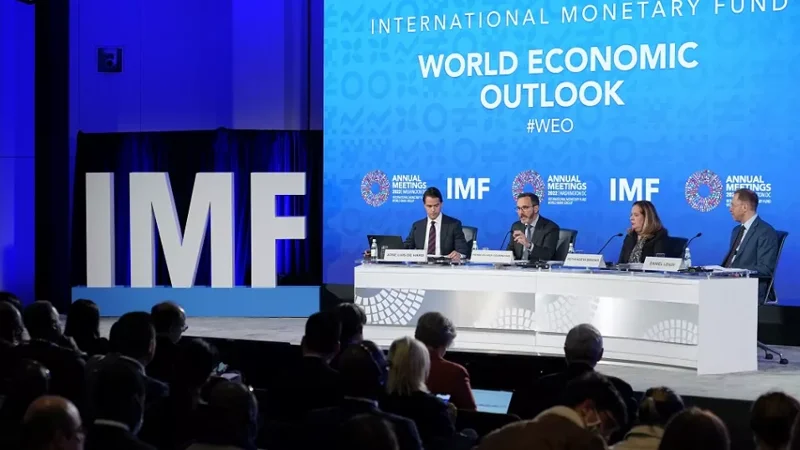
WASHINGTON: The International Monetary Fund (IMF) has warned that global financial markets should not become complacent, highlighting the risks of an artificial intelligence-driven market correction, rising government bond yields and major cyberattacks.
In its Global Financial Stability Report, the IMF said investment in artificial intelligence (AI) had helped support markets despite the economic impact of conflict in the Middle East and broader policy uncertainty. However, it warned that investors may be overestimating the technology’s future returns and the scale of investment required to develop it.
“An AI market correction will affect the real economy,” Athanasios Vamvakidis, deputy director in the IMF’s Monetary and Capital Markets Department, said at a press briefing in Bangkok.
Vamvakidis said strong corporate earnings and optimism surrounding AI had supported global risk appetite. However, he cautioned that market resilience did not necessarily mean the financial system was safe from shocks.
A sharp decline in AI-related valuations could reduce wealth, slow investment and spread losses across broader financial markets, he said.
The IMF identified a potential AI selloff, a sharp rise in sovereign bond yields and a major cyberattack as plausible near-term triggers of financial instability. Although each risk might be manageable individually, the Fund warned that their interaction could expose deeper vulnerabilities and create systemic consequences.
AI Investment and Leverage Risks
The IMF said growing leverage in the AI sector could amplify market losses if investment momentum weakened. Borrowing and other leveraged positions could force investors to sell assets during a downturn, increasing volatility and placing further pressure on prices.
The report noted that major cloud computing and technology companies, known as hyperscalers, accounted for 10% of global investment-grade bond issuance, compared with less than 1% in 2024.
“The consequences of an AI correction could be global,” the IMF warned, urging policymakers to address excessive leverage, including through derivatives and margin loans.
The Fund’s assessment suggests that a correction in AI-related assets could extend beyond technology stocks if it affects corporate borrowing, investment spending and investor confidence.
Rising Bond Yields Add to Pressure
The IMF said risks in bond markets had increased since its April report, partly because higher energy prices had pushed government borrowing costs upward.
High levels of sovereign debt and unresolved fiscal deficits in major economies have added to concerns about the volume of debt governments and private companies need to issue.
“The market is concerned about absorption potential of the huge issuance that is coming from the sovereigns and increasingly also from the private sector,” Vamvakidis said.
He noted that central banks were reducing the size of their balance sheets, leaving markets increasingly dependent on investors who are more sensitive to changes in prices and yields.
Despite these pressures, the IMF said bond markets had so far absorbed the stress relatively well. Hedge funds had been able to reduce some of their borrowing through repurchase agreements without causing major disruption in repo markets.
The Fund urged governments to put public debt on a sustainable path to reduce vulnerabilities and strengthen confidence in financial markets.
Cyberattacks Pose Growing Threat
Cybersecurity was another major concern highlighted in the report. The IMF said limited resources, particularly in emerging markets, and dependence on a small number of critical technology providers were making financial systems more vulnerable.
In more than 70% of cases recorded so far in 2026, software providers had almost no time to patch vulnerabilities before attackers exploited them, the report said. That represented an increase of 20 percentage points from a year earlier.
While artificial intelligence can help identify and address security weaknesses, the technology can also make cyberattacks more sophisticated, the IMF warned.
A major attack targeting a critical service or financial institution could undermine public confidence and rapidly spread disruption across financial markets.
The Fund called on policymakers to strengthen cybersecurity capabilities and tighten oversight of third-party technology providers that support financial institutions.
Banks Remain Resilient, but Weaknesses Persist
The IMF’s stress tests indicated that banks’ capital buffers remained broadly robust under a hypothetical downturn caused by weaker AI investment and fragile bond markets.
However, the results also revealed areas of concern. Banks accounting for 22% of global banking assets were found to have weak capital levels under the latest stress test, compared with 18% in the 2025 assessment.
The findings suggest that the banking system could withstand some forms of market stress, but vulnerabilities remain that could intensify if several risks materialise simultaneously.
The IMF urged policymakers to monitor market developments closely, limit excessive financial leverage, manage public debt responsibly and strengthen cyber defences to reduce the likelihood that a market shock develops into a broader financial crisis.