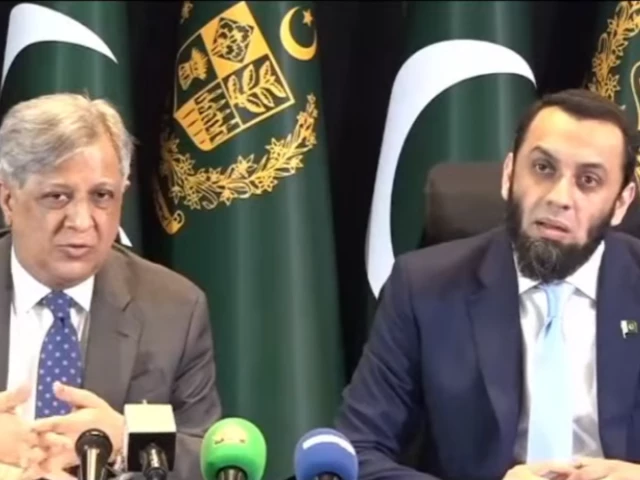
ISLAMABAD, October 13, 2026: Information Minister Attaullah Tarar has claimed that the federal government possesses “credible evidence” of contacts between the Pakistan Tehreek-e-Insaf (PTI) and the banned Tehreek-e-Taliban Pakistan (TTP), saying details of the alleged links would be disclosed later.
Addressing a briefing for foreign correspondents alongside Law Minister Azam Nazeer Tarar, the information minister accused the PTI-led provincial administration in Khyber Pakhtunkhwa (K-P) of failing to adequately support counterterrorism efforts.
“The government has credible evidence that PTI was in touch with the TTP. And very soon, we will be giving you evidence about the links that we have been able to uncover between the PTI and the TTP,” he said.
The allegations were not accompanied by publicly presented evidence during the briefing. Tarar said the government would disclose further details at a later stage.
He also accused the provincial leadership of promoting narratives that undermined law enforcement agencies and alleged that its approach had weakened the fight against terrorism.
Government Cites Rising Terrorism Figures
Tarar said the federal government had observed a significant increase in terrorist incidents, particularly attacks targeting police personnel and installations.
Citing government figures, he said Pakistan recorded 3,774 terrorist incidents in 2025 and 2,857 during the period up to September 2026.
He also claimed that terrorism-related fatalities had risen from 267 in 2021 to 3,512 in 2025, with the figure reaching 2,775 in 2026 by the time of the briefing.
The minister further said attacks targeting police had increased by 168 per cent and that 18 police installations had been targeted over the preceding two years.
Tarar paid tribute to members of the armed forces, police and other law enforcement agencies killed while fighting militancy. He alleged that the K-P government had not provided adequate support to security personnel.
He also questioned how the provincial administration had used its financial resources, claiming that it had received nearly Rs800 billion through the National Finance Commission framework.
The minister argued that greater investment was needed in the Counter Terrorism Department (CTD), Safe City surveillance systems, forensic laboratories, police equipment and programmes to prevent violent extremism.
He said he had visited Kohat following a terrorist incident, met injured people in hospital and visited the families of those killed. According to Tarar, residents affected by violence wanted stronger action to eliminate terrorism.
Federal Government Seeks Unified Counterterrorism Policy
Tarar said negotiations between the federal government and the K-P administration had focused on counterterrorism rather than political demands.
“We had only one agenda. There was no political agenda,” he said.
He maintained that the federal government wanted a unified national policy on counterterrorism and greater coordination between federal and provincial agencies.
The minister also criticised what he described as differences between Islamabad and the K-P administration over engagement with Afghanistan’s interim government.
He argued that Pakistan needed a consistent approach to persuading Kabul to prevent its territory from being used for attacks inside the country.
Tarar alleged that the provincial administration had failed to participate consistently in Apex Committee meetings intended to coordinate security operations. He also criticised its performance in public service delivery, including education and healthcare.
The information minister further alleged that militant networks were connected to illegal economic activities, including cross-border smuggling involving minerals, timber, tobacco, gold and precious stones. He also questioned whether vehicle registration procedures were adequate to help authorities track vehicles used in criminal activities.
These claims were presented by the ministers as part of their case for a more coordinated federal approach to security in K-P.
New Administrative Structure for 12 Districts
Tarar also outlined the proposed administrative arrangements for 12 conflict-affected districts under an Area Representative and Development Council (ARDC).
He said the structure would include a chairman, vice-chairman, council members and spokespersons, alongside an additional chief secretary and senior officials responsible for policing, law enforcement, narcotics control, legal affairs, tribal affairs, human rights, budgeting and revenue.
The minister identified Yahya Akhunzada as the administrator and said the arrangement would maintain regional and tribal representation in decisions concerning security and development.
Tarar said the federal government expected the new administration to improve coordination, restore law and order and support development in affected areas.
“This new setup has come with new hope and has come with a renewed assurance that first and foremost law and order will be maintained,” he said.
He added that the government intended to pursue the alleged PTI-TTP links through the relevant process.
Law Minister Defends Constitutional Intervention
Law Minister Azam Nazeer Tarar defended the federal government’s decision to intervene in K-P, saying it followed consultations with provincial authorities, negotiations over counterterrorism measures and a review of reports on the security situation.
He said Prime Minister Shehbaz Sharif had brought the matter before the federal cabinet, which approved the decision by consensus, according to the minister.
Azam argued that the Constitution provided mechanisms for federal intervention when internal disturbances became severe and provincial authorities were unable to maintain law and order.
“Pakistan is a federation. So there is a division of powers,” he said, adding that federal and provincial governments exercised authority within their respective constitutional domains.
He referred to Articles 232 and 234 of the Constitution, which concern emergency provisions and the failure of constitutional machinery in a province.
According to the law minister, the presidential proclamation authorised the federal government to assume responsibility for provincial affairs or delegate certain responsibilities to the governor.
He said the proclamation had been issued after what he described as thorough deliberations and consideration of available reports and other material.
Azam maintained that similar constitutional provisions had been invoked on several occasions by elected governments in the past.
He also said the proclamation would be subject to the approval procedures prescribed by the Constitution, including consideration by Parliament. Referring to Article 234, he said the relevant process included placement before a joint sitting.
On the duration of governor’s rule, the minister said the Constitution provided for a maximum period of six months under Article 234, while stressing that the precise duration would depend on how the situation developed.
Ministers Compare Security Responses in K-P and Balochistan
Azam said the federal government had assessed the security situations in K-P and Balochistan differently, citing what he described as differences in the provincial administrations’ cooperation with security agencies.
He praised the Balochistan chief minister for engaging with security institutions, visiting affected areas, supporting rehabilitation efforts and meeting injured people and bereaved families.
“Your actions speak louder than your words,” the law minister said.
He contrasted that response with what he described as inadequate cooperation from the K-P administration.
Azam also cited government figures suggesting that terrorist-related incidents in K-P had increased sharply between two periods. He said the province recorded approximately 2,900 incidents between 2021 and 2024, compared with around 8,600 between 2024 and 2026.
Pakistan Plans More Panda Bonds in China, Explores Samurai Bonds in Japan
He described the change as a 195 per cent increase and referred to attacks against provincial police, security forces, customs officials and religious scholars.
The minister also cited the killing of nine customs officials in a suicide attack as an example of the security challenges facing the province.
He said federal authorities had explored negotiations and political engagement before deciding to invoke the constitutional provisions, but the discussions had not produced the desired agreement on a coordinated counterterrorism strategy.
Azam expressed hope that the new administrative arrangement would improve security, while acknowledging that the time needed to achieve that objective remained uncertain.
The ministers maintained that the federal government’s actions were intended to restore law and order, improve coordination among security agencies and protect residents of K-P.
The alleged links between PTI and the TTP, however, remain claims made by the federal government. Their evidentiary basis and any response from PTI would be important to assessing the allegations independently.