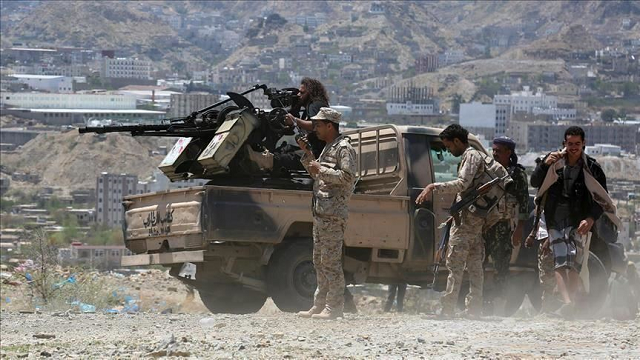
Yemen’s army said Friday that 30 Houthi fighters were killed and more than 60 wounded during 24 hours of clashes and airstrikes in Al-Waziyah district, west of Taiz.
The figures were provided by the Yemeni military and could not be independently verified. A military source said government aircraft also targeted Houthi vehicles and gathering points in the area.
The army said its air force had also targeted Houthi supply routes and deployment positions in Taiz and the Red Sea port city of Mocha.
Government forces have increased attacks on Houthi positions in several provinces in recent days. Taiz remains one of the main areas of fighting.
Italy Prepares Naval Escort Mission
The escalation has also raised concerns about shipping through the Bab el-Mandeb Strait, a key maritime route connecting the Red Sea with the Gulf of Aden.
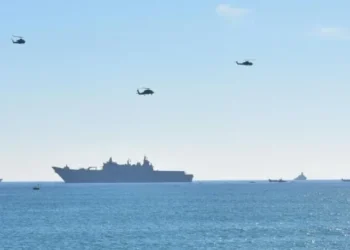
Italian Defence Minister Guido Crosetto said Italy was preparing measures to protect Italian merchant vessels rather than wait for the European Union’s Red Sea mission to decide on further action.
Kim Yo Jong Warns of Stronger Response to US-Led Military Drills
Crosetto said military officials had been instructed to assess the security situation and prepare a plan for safe passage.
Italy is considering whether naval assets already operating in the region can temporarily come under national command or whether additional parliamentary approval would be required.
Crosetto warned that prolonged disruption to the sea route could delay deliveries and increase costs for businesses and consumers.
The Italian frigate Bergamini is currently stationed in Djibouti, while Italian-linked commercial vessels are seeking safer passage through the region.
Tanker Incidents Raise Hormuz Concerns
Security concerns have also spread to the Strait of Hormuz.
The United Kingdom Maritime Trade Operations reported that a tanker was struck by an unidentified projectile in the waterway. A fire broke out but was later extinguished, and the crew was reported safe.
The environmental impact remained unclear.
Iran separately claimed that its Revolutionary Guard Navy struck a Togo-flagged tanker called Trend after accusing the vessel of attempting an “illegal passage” through the Strait of Hormuz.
Iranian state media said the vessel caught fire and was stopped. The claim was not independently verified, and the Iranian statement did not provide details about possible injuries, the cargo or the vessel’s condition.
Commercial traffic through Hormuz has fallen sharply amid the wider regional conflict. Preliminary shipping data showed only four commodity vessels crossed the strait on Thursday, compared with a 10-day average of 16.
Saudi Arabia and Houthis Exchange Strikes
The latest fighting comes as Saudi Arabia and the Houthis continue exchanging attacks across the border.
Houthi-controlled media reported Saudi airstrikes in Hajjah province near the Red Sea coast and around Taiz.
Saudi authorities have also reported casualties from debris linked to intercepted Houthi drones. Reuters reported that the fighting has created additional risks for energy supplies and maritime trade.
The renewed conflict has also forced civilians to flee.
The International Organization for Migration said more than 100,000 Yemenis had been displaced by the latest fighting, with people also crossing the Red Sea by boat toward Djibouti. A newer UN migration estimate put internal displacement at at least 112,000, with nearly 3,000 people fleeing by sea to Djibouti.
Wider Conflict Threatens Global Energy Supplies
The fighting in Yemen has added pressure to two of the region’s most important maritime routes: Bab el-Mandeb and the Strait of Hormuz.
Bab el-Mandeb is critical for shipping between the Red Sea and the Gulf of Aden, while Hormuz is a major route for global oil and gas shipments.
Shipping traffic through both waterways has fallen amid the security crisis. Reuters reported that 23 commodity vessels crossed Bab el-Mandeb on Thursday, below the recent 10-day average.
The escalation has therefore increased concerns about energy supplies, shipping costs and the broader economic impact of the Middle East conflict.
At the same time, diplomatic efforts remain focused on preventing the conflict from spreading further across the region.