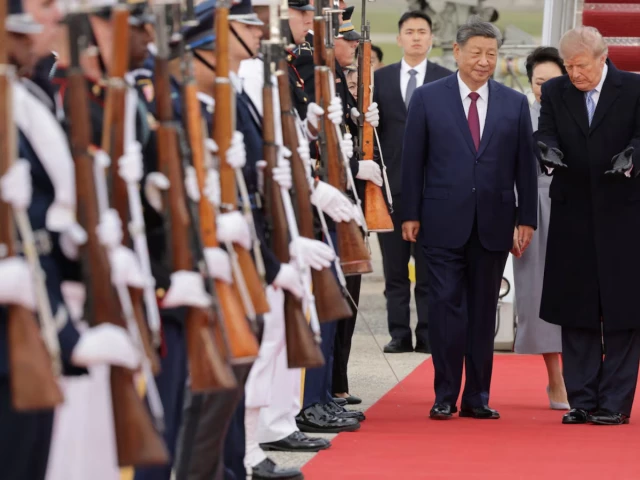
US President Donald Trump welcomed Chinese President Xi Jinping to Washington on Wednesday ahead of a high-profile White House summit focused on trade, technology and broader tensions between the world’s two largest economies.
Xi’s visit marks his first trip to the United States in nearly three years and his first visit to Washington in more than a decade. The two leaders are meeting for the second time this year after holding talks in Beijing in May.
Trump personally greeted Xi and his wife, Peng Liyuan, at Joint Base Andrews in Maryland, marking an unusual departure from protocol. Reuters reported that the welcome was the first time in 11 years that a US president had personally greeted a foreign leader at the military base.
Xi said ahead of the summit that China and the United States should be “partners, not rivals” and expressed hope for a more stable bilateral relationship.
The summit comes as Washington and Beijing continue to manage disputes over tariffs, rare-earth minerals, Taiwan, export controls and artificial intelligence.
A major development ahead of the meeting was an agreement to extend the existing US-China trade truce. US Treasury Secretary Scott Bessent said the arrangement, originally due to expire on November 10, would be extended by two months until January 10, providing additional time for negotiations.
Pakistan Strikes 10 Afghan Sites After Drone Incursion, Tarar Says
The two sides could also discuss further tariff adjustments, cooperation against drug trafficking and expanded military-to-military communication. Trump is also expected to raise the issue of Americans and other foreign nationals detained in China, according to people familiar with the preparations.
Taiwan remains one of the most sensitive issues in the relationship. Beijing claims sovereignty over the self-governed island, while Washington maintains security and diplomatic ties with Taipei. Reuters reported that Xi was expected to raise Taiwan during his talks with Trump, while the US president was expected to maintain restrictions on sensitive technology exports to China.
Artificial intelligence is another potential area of discussion. The United States and China are competing heavily in AI development while also examining ways to reduce the risks posed by increasingly capable systems. US officials have discussed the possibility of stronger communication mechanisms between the two countries to prevent incidents from escalating.
Iran is also expected to feature in the talks as Washington seeks to manage the wider geopolitical consequences of the conflict. China has maintained relations with Iran, while the US has sought greater pressure on Tehran.
The summit is accompanied by an extensive programme of diplomatic ceremony, including a state dinner attended by senior figures from the technology industry, a White House military ceremony and a planned visit to the National Archives. Among the technology leaders expected at the dinner are Apple CEO Tim Cook, Nvidia CEO Jensen Huang and OpenAI CEO Sam Altman.
Despite the elaborate welcome, Reuters reported that expectations for a broad breakthrough remain limited. Both governments are seeking to maintain stability in the relationship while continuing to compete over trade, technology and strategic influence.
Another Trump-Xi meeting could take place later this year, potentially during the Asia-Pacific Economic Cooperation summit in China in November or the G20 meetings in the United States in December.