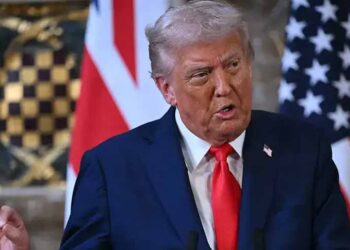
US President Donald Trump has renewed his threat of military action against Iran, intensifying questions about public support for the conflict and Congress’s ability to restrain further escalation.
With the US midterm elections scheduled for November 3, opinion polls indicate widespread dissatisfaction with the war, particularly over rising fuel prices and the risk of American troops being wounded or killed. Reports of renewed US-Israeli military planning have also fuelled concerns about possible strikes after the elections.
Trump issued his latest threat at a rally in Florida on Friday.
“We may do another little Epic Fury,” he said, referring to the US military operation against Iran. He did not provide details about when another operation might begin.
Rotary Reaffirms Commitment to End Polio in Pakistan on World Polio Day
White House spokesperson Anna Kelly, however,“the United States will not be attacking Iran at any time prior to the midterm elections.”
Although the reports suggest that further military action is under consideration, they do not establish that Trump has ordered another attack. Diplomatic negotiations remain a possible alternative.
Strategic Options and Political Pressure
In an analysis published on October 23, James M. Lindsay, a senior fellow at the Council on Foreign Relations, outlined three possible paths for Trump: escalating the conflict, negotiating with Tehran or maintaining the current position.
“All three options have substantial downsides and a questionable likelihood of succeeding,” Lindsay wrote.
Renewed attacks could increase pressure on Iran but risk prolonging the conflict without delivering a political settlement. Negotiations would require Washington and Tehran to bridge significant differences, while maintaining the current position could leave the conflict unresolved.
Andrew Payne, research director for Europe, Russia and the Americas at Chatham House, argued in an October 15 analysis that foreign policy could play an unusual role in this year’s midterm elections.
The economic consequences of the war could influence voters who might otherwise concentrate primarily on domestic issues, particularly the rising cost of living.
Public Opinion Turns Against the War
A Pew Research Center survey conducted from September 28 to October 4 among 5,062 US adults found that 65 per cent disapproved of Trump’s handling of the military action against Iran, while 33 per cent approved.
The survey also found that 73 per cent were extremely or very concerned about higher fuel prices, while 71 per cent expressed similar concerns about American troops being wounded or killed. Nearly half of respondents, or 47 per cent, expected the military action to continue for more than another year.
A separate Associated Press-NORC poll published on October 22 found that approximately seven in 10 registered voters wanted the next Congress to make ending the Iran war a top priority. About eight in 10 assigned similar importance to reducing the cost of living.
The poll surveyed 1,119 US adults between October 8 and 12.
The findings highlight growing pressure on the administration to address the duration and economic consequences of the conflict. However, dissatisfaction with Trump’s handling of the war does not necessarily mean voters would oppose every potential military operation.
Can Congress Restrain Trump?
Congress has several tools to scrutinise military operations, conduct oversight hearings and influence the direction of the conflict through its control over federal spending. Lawmakers can also invoke the War Powers Resolution to challenge military action.
The resolution requires the president to notify Congress in certain circumstances when US forces enter hostilities. It also establishes procedures through which lawmakers can consider whether military action should continue.
Funding could become particularly significant if the conflict expands. Congress can approve, restrict or attach conditions to spending for military operations, potentially increasing the political cost of a prolonged campaign.
The strength of congressional opposition would depend partly on whether Republicans remain united behind Trump. If some Republican lawmakers join Democrats in challenging the war, the administration could face greater scrutiny over its objectives, military strategy and plans for ending the conflict.
However, even a congressional challenge would not automatically prevent the president from ordering another strike.
What Happens After November 3?
The immediate question is whether Trump will maintain his stated position against attacking Iran before the midterm elections. The broader issue is whether the election results will change the political constraints surrounding his decisions.
Reported military planning and Trump’s latest remarks have kept the possibility of renewed strikes in focus, but neither confirms that an attack has been scheduled.
A change in control of either chamber of Congress could reshape oversight and funding debates, although it would not automatically prevent further military action.
Whether public dissatisfaction, economic concerns and congressional scrutiny push Trump towards negotiations or renewed military strikes remains uncertain.