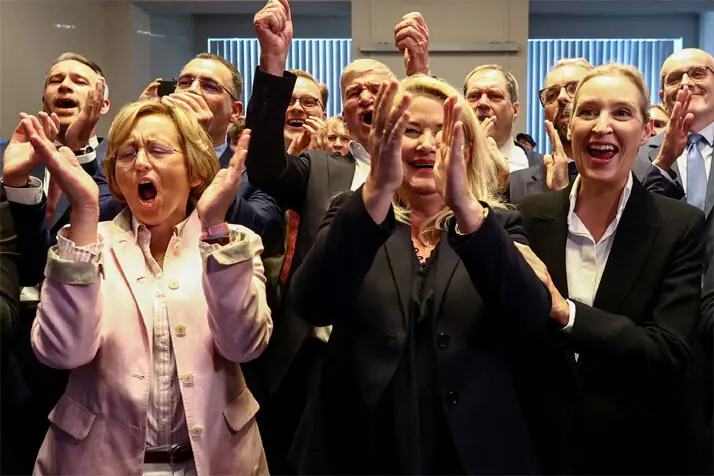
Germany’s Alternative for Germany (AfD) emerged as the strongest party in Mecklenburg-Western Pomerania, while the Left Party (Die Linke) topped the vote in Berlin, delivering another setback to Chancellor Friedrich Merz’s Christian Democratic Union (CDU).
In Mecklenburg-Western Pomerania, the AfD secured 38.2% of the vote, ahead of the centre-left Social Democratic Party (SPD), which received 35.5%, according to preliminary official results. The CDU received just 4.9% and failed to cross the five-percent threshold required to enter the state parliament.
The result marked the AfD’s first time emerging as the strongest party in Mecklenburg-Western Pomerania and followed its strong performance in Saxony-Anhalt earlier this month. Despite its gains, the party remains unlikely to form a state government because other major parties have ruled out cooperation with it under Germany’s political “firewall” approach.
The result also represented the CDU’s worst performance in a German state election since the Federal Republic was founded in 1949. Merz described the outcome as a “disaster” but said he would continue with his reform programme.
Ishaq Dar Arrives in New York as 81st UN General Assembly High-Level Week Begins
“The reforms have to come,” Merz said after the results, signalling that he intended to remain in office and pursue his agenda despite growing political pressure.
In Berlin, meanwhile, Die Linke won 25.3% of the vote, ahead of the CDU on 20%. The AfD secured 16.3%, while the result opened the possibility of a new governing coalition involving the Left Party, the SPD and the Greens.
Die Linke’s Berlin campaign focused heavily on the city’s housing crisis, rising rents and proposals to bring large numbers of privately owned housing units under public control. Its lead candidate, Elif Eralp, campaigned on stronger measures to address housing costs and curb speculation.
The two state elections have increased scrutiny of Merz’s leadership after a series of difficult results for the CDU. The chancellor has faced criticism over economic conditions, unpopular reforms and declining approval ratings, while the AfD has continued to gain support in national polling and state-level elections.
The elections also highlighted a broader shift in Germany’s political landscape, with support for both the far right and far left increasing in some regions while traditional centrist parties face pressure. Reuters reported that economic stagnation, high living costs and concerns over fuel prices have contributed to voter dissatisfaction with established parties.
For the AfD, the results strengthen its position as a major force in German politics. The party has campaigned for tougher immigration controls and changes to Germany’s relationship with Russia and the European Union, positions that have helped it attract support beyond its traditional base.
However, its ability to translate electoral gains into governing power remains constrained by the refusal of other major parties to enter coalitions with it. The latest results therefore underline both the AfD’s growing electoral strength and the continuing political isolation that limits its immediate access to government.
For Merz, the elections have intensified questions about the direction of his government and the CDU’s response to the changing political landscape. Despite the setbacks, he has publicly committed to continuing his reform agenda rather than changing course.