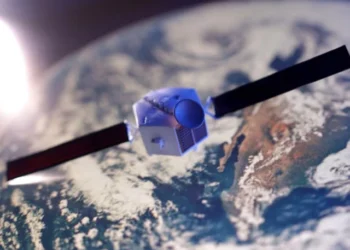
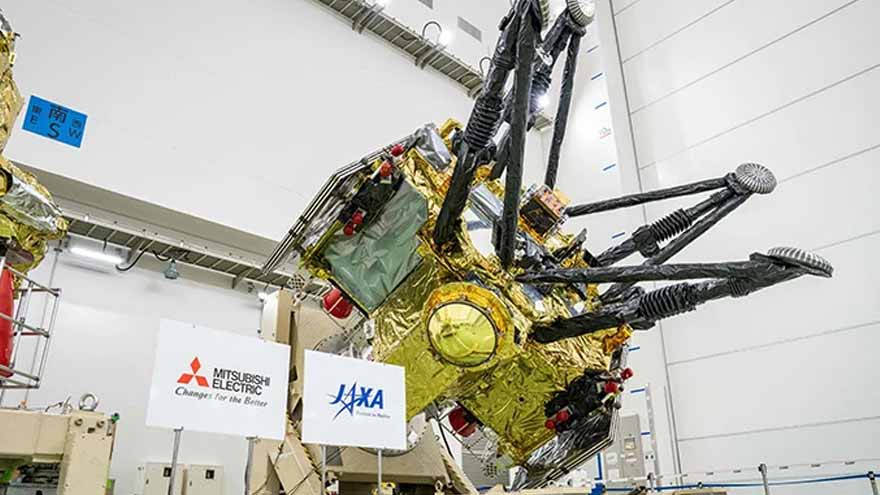
Mars Mission MMX is preparing to travel to the Red Planet’s moons and return samples that could help scientists understand the origins of the Solar System and the conditions that supported life on Earth.
Japan’s Aerospace Exploration Agency (JAXA) plans to launch the unmanned Martian Moons eXploration spacecraft from Tanegashima Space Center in the coming months.
The spacecraft will spend about three years around Mars. It will attempt to land on Phobos and collect at least 10 grams of material from its surface.
The French-built IDEFIX rover will also study Phobos during the mission. MMX will observe Deimos, Mars’ other moon, without landing there.
After completing its observations, the spacecraft will send a return capsule toward Earth. The capsule is expected to land in Australia around 2031.
UFC 330 Islam Makhachev Retains Welterweight Title Against Ian Machado Garry
Scientists seek clues to Solar System origins
JAXA hopes the samples will help scientists determine how Mars and its moons formed.
Scientists currently consider two main theories about the origins of Phobos and Deimos.
The “giant impact” theory suggests that a large celestial body collided with Mars. The resulting debris may have eventually formed the two moons.
The alternative “capture” theory suggests that Phobos and Deimos are asteroids from the outer Solar System. Mars may have captured them through its gravity.
Solving the mystery could provide important clues about how rocky planets developed habitable environments.
French astrophysicist Patrick Michel, who works on IDEFIX, said the mission could also reveal how water, organic compounds and other materials moved from the outer Solar System toward the inner planets.
Those materials may have contributed to the conditions that allowed life to emerge on Earth and other rocky worlds.
Phobos could support future Mars missions
JAXA also wants MMX to test technologies that could support future human missions to Mars.
The agency is studying whether Phobos could eventually serve as a “natural space station” for missions to the Martian system.
MMX will therefore provide experience in landing, operating and returning from the Mars region. JAXA considers those capabilities important for future crewed exploration.
The mission involves Japan, France, Germany, the United States and Europe. CNES, DLR, NASA and ESA are among the organisations participating alongside universities and technology companies.
Landing on Phobos poses challenges
Landing on Phobos presents a major engineering challenge because the moon has extremely weak gravity.
Akinari Uehara, a Mitsubishi Electric engineer, said engineers must design landing legs that absorb the impact and prevent the spacecraft from falling after touchdown.
Japan has already gained valuable experience from its SLIM lunar mission. The spacecraft tipped over after landing on the Moon in 2024 but continued transmitting data.
JAXA also successfully returned asteroid samples with Hayabusa-2. The spacecraft brought 5.4 grams of rock and dust back to Earth in 2020.
China also races to return Mars samples
Japan is not the only country pursuing Martian samples.
NASA’s Perseverance rover has collected samples on Mars since 2021. However, plans to return those samples to Earth have faced major changes and funding challenges.
China is also developing its Tianwen-3 mission. Beijing plans to launch the spacecraft around 2028 and return Mars samples around 2031.
That timeline could allow China to bring Martian material back to Earth before Japan returns its Phobos samples.
China previously achieved another major milestone with Tianwen-1. The mission successfully placed the Zhurong rover on Mars in 2021.
The race to retrieve material from Mars and its moons could provide scientists with unprecedented evidence about planetary formation, the movement of life-building materials and the early history of the Solar System.