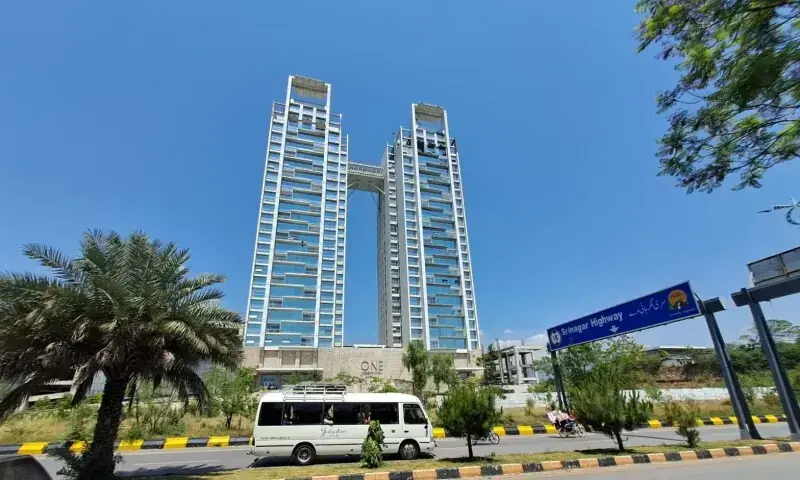
The Islamabad High Court (IHC) on Monday issued a detailed judgment in the high-profile One Constitution Avenue case, upholding the Capital Development Authority’s (CDA) decision to cancel the lease of the multi-billion-rupee real estate project in the federal capital.
The verdict was announced by IHC Chief Justice Sardar Muhammad Sarfraz Dogar, who dismissed petitions filed by M/s BNP (Pvt) Limited — the developer of the project — along with investors and other stakeholders. The petitions had challenged the CDA’s termination of the lease agreement.
The court ruled that apartment buyers in the luxury development do not hold independent ownership rights, as their claims are dependent on the validity of the developer’s lease. With the lease now lawfully terminated, the court held that no legal ownership interest could be transferred to buyers. However, it noted that affected investors may pursue recovery of their investments directly from the developer through appropriate legal channels.
The dispute stems from a 2005 lease agreement between CDA and BNP for the construction of a five-star hotel, which was later converted into a high-end residential and commercial project known as One Constitution Avenue. The lease was first terminated in 2016 but reinstated by the Supreme Court in 2019 under strict financial conditions, including Rs17.5 billion in payments over eight years backed by bank guarantees.
The IHC observed that the Supreme Court’s earlier judgment formed a binding legal framework, and strict compliance with its terms was mandatory. The court found that BNP failed to meet its financial obligations, including delayed instalment payments and failure to provide acceptable bank guarantees.
Rejecting the developer’s argument that CDA administrative delays caused non-compliance, the court held that such claims could not justify prolonged default. It further noted that the developer failed to demonstrate financial readiness to meet its obligations.
On procedural grounds, the court ruled that CDA had issued proper notices before terminating the lease and had provided sufficient opportunity to cure the default. Therefore, the termination was neither arbitrary nor unlawful.
The court also dismissed allegations of mala fide intent, stating that CDA acted within its statutory authority and in line with Supreme Court directives. It emphasized that administrative actions aligned with judicial orders cannot be lightly interfered with.
The judgment also addressed concerns of apartment buyers and investors, stating that they had entered transactions with the developer at their own risk and could not claim protection against CDA in the absence of a valid lease.
Justice Dogar, however, noted that investors retain the right to seek recovery from the developer through civil proceedings.
The case has recently drawn public attention following reports of eviction notices and heavy police presence at the site. Social media videos showed law enforcement activity at the building, sparking widespread debate. Reports also indicated that prominent figures, including politicians and former officials, own apartments in the project.
Earlier, Prime Minister Shehbaz Sharif had constituted a committee to review the situation and temporarily halted enforcement actions.
With this judgment, the IHC has effectively closed the legal challenge to the CDA’s lease cancellation, reinforcing regulatory authority over public land development disputes.