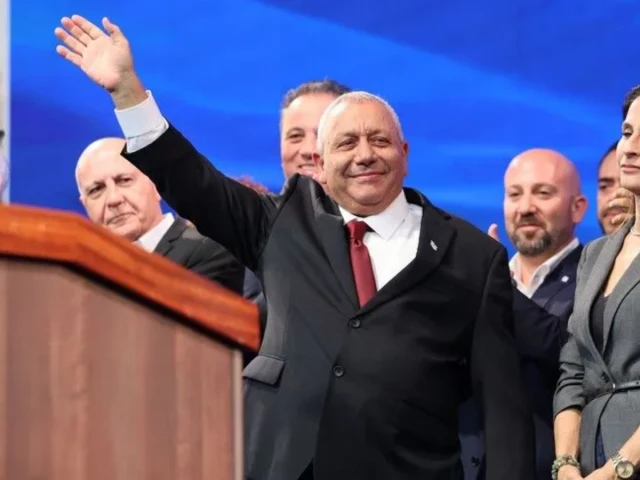
Israel’s Yashar party, led by former military chief Gadi Eisenkot, has agreed to a coalition deal with right-wing opposition leader Avigdor Lieberman as efforts to form a new government gather pace following last month’s inconclusive election.
Yashar said Eisenkot met Lieberman, head of the Israel Our Home party, on Tuesday, with both leaders agreeing to the arrangement afterward. The agreement marks the first formal coalition pact since the October 27 election.
Israel’s parliament was sworn in on November 10 without a new government after the election deprived Prime Minister Benjamin Netanyahu of his parliamentary majority but failed to give his opponents a clear path to power.
President Isaac Herzog has tasked Eisenkot with forming the next government. Netanyahu remains in office as caretaker prime minister while coalition negotiations continue.
Eisenkot Faces Challenge to Secure Majority
Netanyahu’s right-wing Likud alliance with far-right and ultra-Orthodox parties performed better than expected in the election but fell short of a majority, securing 53 seats in the 120-member Knesset.
Houthis Claim Attacks on Saudi Oil Refinery and Riyadh Financial District
Eisenkot’s centre-right Yashar party and its potential coalition partners hold 48 seats. However, they could seek support from parties representing Israel’s Arab minority, which collectively control 19 seats and strongly oppose Netanyahu.
Yashar won 21 parliamentary seats, while Lieberman’s Israel Our Home secured seven.
The agreement between the two leaders came as something of a surprise because Lieberman has repeatedly opposed forming a government that depends on Arab parties. He has also rejected the prospect of joining a unity government with Netanyahu.
Lieberman has nevertheless made removing Netanyahu from power one of his main political objectives.
Democrats Suspend Coalition Talks
Eisenkot has until December 6 to form a government under the 28-day mandate granted by President Herzog. He can request an additional 14 days if he needs more time.
If Eisenkot fails, Netanyahu could receive an opportunity to form a government. If neither leader succeeds, Israel could face another election next year.
Meanwhile, negotiations continue between Eisenkot, several partners in the so-called change bloc and Likud over the possibility of forming a national unity government.
The left-wing Democrats party, which won eight seats, announced that it was suspending coalition negotiations with Eisenkot.
The party cited progress in talks between Eisenkot and Netanyahu’s Likud over a possible unity government, as well as a deadlock in negotiations to establish a government without Netanyahu.
Democrats leader Yair Golan has said he prefers a government that excludes Netanyahu but includes Arab parties.
The latest developments leave Eisenkot facing a difficult balancing act as he attempts to bring together parties with sharply different positions on the role of Arab lawmakers and the possibility of a unity government with Likud.