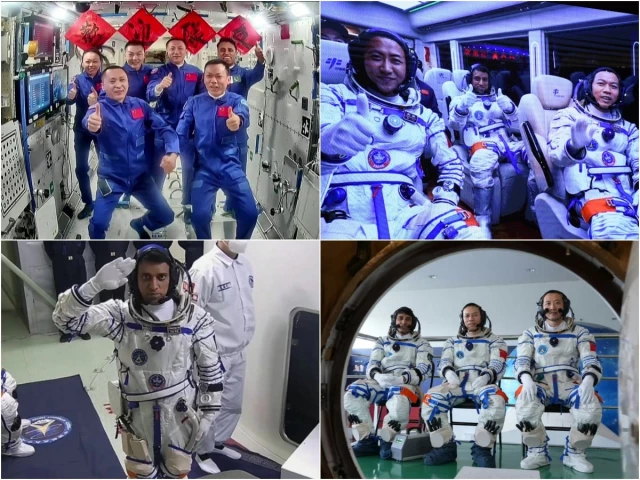
Pakistan has entered a new chapter in its space programme as Zeeshan Ali became the country’s first astronaut to travel into orbit and join China’s Tiangong space station aboard the Shenzhou-24 spacecraft on Wednesday.
The spacecraft, carried by a Long March-2F rocket, lifted off from the Jiuquan Satellite Launch Centre in northwest China at 8:18am Beijing time, according to the China Manned Space Agency (CMSA).
The spacecraft separated from the rocket about 10 minutes after launch and entered its designated orbit. The CMSA described the launch as a complete success.
The Shenzhou-24 spacecraft was scheduled to perform an automated rendezvous and docking manoeuvre with the Tiangong space station before its crew entered the orbital facility.
The three-member crew comprises mission commander and spacecraft pilot Tang Hongbo, flight engineer Wu Yi and Pakistani astronaut Zeeshan Ali.
The 40-year-old Pakistani pilot will serve as a payload specialist and is expected to stay aboard the space station for five to 10 days.
Scientific experiments and joint research
More than 90 scientific experiments and technology tests are planned during the Shenzhou-24 mission, covering space life sciences, materials science, microgravity fluid physics, combustion science, fundamental physics, space medicine and emerging space technologies.
According to CMSA spokesperson Zhang Jingbo, four joint China-Pakistan projects in biotechnology and materials science will also be conducted during the mission.
Azan Awais, Pakistan Pacers Rise in Latest ICC Test Rankings
Ali will carry out an in-orbit experiment involving photosynthetic cyanobacteria. He will also contribute to research examining how self-healing carbon-fibre composites can automatically repair small cracks in spacecraft.
After completing the joint flight, Ali is scheduled to return to Earth aboard the Shenzhou-23 spacecraft alongside two members of its crew.
The other two Shenzhou-24 astronauts will remain aboard Tiangong for approximately six months, together with Shenzhou-23 astronaut Zhu Yangzhu, who is expected to complete a year-long stay in orbit.
Seven months of training in China
Ali underwent seven months of intensive training in Beijing to prepare for the mission. His preparation included Chinese-language lessons, learning Chinese songs and poetry, practising calligraphy and playing table tennis.
Speaking to reporters ahead of the launch, Ali said he was carrying the hopes of his country.
“I’m not flying for myself. I carry the name of Pakistan on my shoulder,” he said.
He described the mission as the beginning of a broader partnership between the two countries, expressing hope that future cooperation would expand from individual astronaut flights to joint missions to the Moon, Mars and beyond.
Addressing his family, Ali said that although he would travel farther from home than ever before, he would look for the light of home when he first saw Earth from space.
Prime Minister Shehbaz congratulates the nation
Prime Minister Shehbaz Sharif congratulated the nation on Ali’s departure, describing the mission as a historic achievement for Pakistan.
“Today Pakistan has begun its journey beyond the stars,” the prime minister said.
He added that the mission represented the aspirations of 240 million Pakistanis, particularly young people, scientists and researchers.
Shehbaz also praised Ali and fellow Pakistani astronaut candidate Khurram Daud, saying both had completed their training in China with hard work, discipline and dedication.
According to the Prime Minister’s Office, Shehbaz thanked China for including Pakistan in the mission and described the flight as evidence of the close friendship between the two countries.
He also acknowledged the contributions of the Space and Upper Atmosphere Research Commission (SUPARCO), universities and scientists whose experiments are part of the mission.
Addressing young Pakistanis, the prime minister said the achievement should encourage them to pursue scientific ambitions and work towards future milestones in space exploration.
Ahsan Iqbal witnesses historic launch
Planning Minister Ahsan Iqbal attended the launch ceremony at the Jiuquan Satellite Launch Centre, representing the Pakistani government and people alongside a high-level delegation.
He described Ali’s journey as the beginning of a new era for Pakistan’s space programme and bilateral cooperation with China.
Iqbal said Ali was the first Pakistani astronaut to travel into space and the first international guest to join China’s space station through a collaborative mission.
He also recalled proposing expanded space cooperation with China during 2017-18, following the development of major infrastructure projects under the China-Pakistan Economic Corridor (CPEC).
The minister expressed hope that the mission would lead to further joint initiatives, potentially including lunar exploration.
He also paid tribute to Khurram Daud, who completed the astronaut training programme alongside Ali but was not selected for the available seat on this mission.
Expanding international space cooperation
China has promoted its Tiangong space station, whose name means “Celestial Palace”, as a platform for international scientific cooperation.
The station has been fully operational since late 2022 and can accommodate up to six astronauts during crew handovers.
Pakistan and China have cooperated in space research since the early 1990s. China has launched Pakistani satellites, while a Pakistani-built rover is expected to take part in a Chinese lunar mission around 2028.
China aims to send astronauts to the Moon by 2030 and establish a lunar research base by 2035 in cooperation with Russia. The United States has also set a target of returning humans to the Moon by 2028.
Ali’s mission marks a significant step in Pakistan’s participation in international space research and creates opportunities for further scientific cooperation with China.