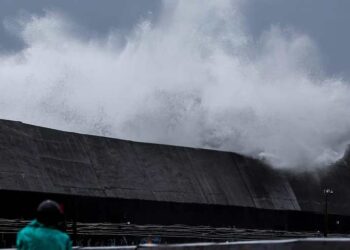
Typhoon Champi moved towards China on Saturday after battering Taiwan and Japan’s southernmost islands, killing one person, injuring more than 600 and forcing the cancellation of hundreds of flights.
The storm weakened to a tropical storm, with wind speeds dropping to 102 kilometres per hour (63 miles per hour), according to the latest update from the Joint Typhoon Warning Centre.
Taiwanese authorities evacuated more than 5,000 people from their homes ahead of the storm, which toppled trees, damaged power lines and triggered temporary flooding.
One person was killed and more than 600 injured since Thursday, when the government began issuing typhoon warnings.
Power has been restored to more than 90 per cent of the over 340,000 households affected by the storm, which brought fierce winds and heavy rainfall across large parts of Taiwan.
ATC Directs Imaan Mazari, Hadi Chattha to Record Statements on October 26
Most shops in northern and central Taiwan remained closed for a second consecutive day as Champi moved away from the island’s northeast and headed north towards China.
“Although the typhoon is gradually departing, we would like to remind the public that coastal areas will still experience swells and strong wind gusts,” Central Weather Administration official Wuu Woan-hwa said at a briefing.
Taiwan Residents Describe Frightening Conditions
Champi briefly reached super typhoon strength while crossing the Pacific in recent days, with reported maximum sustained wind speeds approaching 300 kilometres per hour.
Its intensity weakened overnight as it made a loop off Taiwan’s northeastern county of Yilan, where at least 65 centimetres (26 inches) of rain had fallen since Thursday, according to the weather forecaster.
Martha Wang said she feared being “blown away” while riding her scooter across a bridge in New Taipei City on Saturday morning.
“I was really scared because I was on the bridge. My scooter was shaking,” the 55-year-old secretary told AFP.
William Yu, however, said the storm did not seem unusually severe compared with previous typhoons.
“I went to the convenience store to eat yesterday (evening), and everything was fine,” the 55-year-old librarian said.
China Braces for Heavy Rain and Strong Winds
Chinese authorities warned of strong winds and heavy rainfall as Champi approached the country’s eastern coast, state broadcaster CCTV reported.
Some train services were suspended, while tens of thousands of people were evacuated from their homes in Shanghai.
“Some areas of Jiangsu, Shanghai, Zhejiang, and other regions are expected to experience heavy to torrential rainfall,” CCTV reported.
The approaching storm also disrupted air travel across the region, with hundreds of flights cancelled, including services in Japan’s southernmost prefecture of Okinawa.
Authorities in Okinawa reported that two people had been injured in the typhoon.
On Ishigaki island, tourists waited for flights to resume so they could return home.
“We hope it’s our last day,” Eva Malek, 49, from Poland told AFP.
“It’s not easy to have information. We were not aware of the situation and didn’t expect something like this to happen. When the typhoon arrived, we didn’t think it would be that strong,” she said.
El Niño Raises Concerns Over Extreme Weather
Champi is the latest major storm in an active Pacific typhoon season unfolding amid the El Niño weather phenomenon, which is associated with unusually warm sea surface temperatures in the equatorial Pacific.
The United Nations warned on Wednesday that the El Niño system affecting the planet was intensifying significantly and urged countries to take urgent steps to prepare for potential impacts.
El Niño is expected to peak in December, with its effects potentially continuing into 2027 and beyond.
The natural climate cycle temporarily raises sea temperatures across the tropical Pacific, altering weather patterns worldwide. These changes can increase the risk of droughts and flooding and contribute to the effects of human-caused global warming.
As Champi approaches China, authorities across the affected region face the immediate challenge of managing heavy rainfall, strong winds, transport disruption and the risk of further flooding.