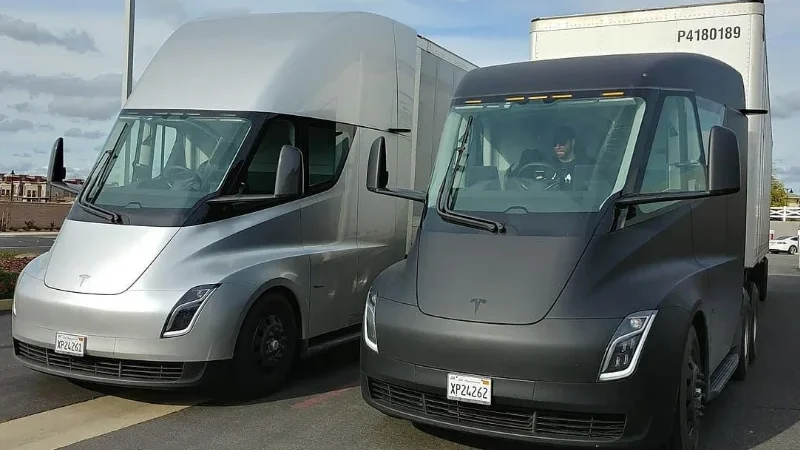
Tesla has begun high-volume production of its Semi electric truck at its Nevada factory, marking a major step in the company’s effort to expand further into the commercial trucking market.
The company also started deliveries to a new group of customers this week, nearly nine years after CEO Elon Musk first unveiled the heavy-duty electric truck.
Tesla did not disclose the Semi’s pricing or initial production figures at a factory event on Thursday. However, the company reiterated its plan to eventually produce 50,000 trucks annually at the Nevada facility.
Musk did not attend the event in person but appeared in a recorded video message encouraging customers to place orders. He said the waiting list for the Semi was already significant.
Representatives from customers including PepsiCo, DHL and US Foods attended the event, with Semis carrying the companies’ logos displayed outside the factory.
According to Tesla, the long-range version of the Semi can travel up to 500 miles on a full charge while loaded, while the standard version has an estimated range of 325 miles.
Dan Priestley, Tesla’s director of Semi truck engineering, said customers had validated the vehicle’s 500-mile real-world range.
Priestley said the factory is expected to produce about 1,000 Semis per week during its initial ramp-up before eventually reaching the company’s annual target of 50,000 trucks. Tesla also expects the expansion to create more than 3,000 jobs in Nevada.
Tesla unveiled the Semi in 2017 and initially expected production to begin in 2019. Limited deliveries to customers such as PepsiCo eventually started in late 2022, but broader production faced several delays.
Simple Rice Storage Tips to Keep Insects Away
The company’s July shareholder letter said Semi production would begin in 2026, following earlier production targets. The first truck eventually came off the high-volume production line in April.
Despite the delayed rollout and increasing competition in the electric trucking sector, recent orders indicate continued commercial interest in the vehicle.
Industry coalition ZET SCALE said it had selected Tesla as its primary original equipment manufacturer for an initial order of 2,500 Semis. The group plans to pursue more than 10,000 electric trucks from multiple manufacturers.
Swedish freight technology company Einride also announced last month that it had agreed to order 500 Tesla Semis for its fleet, with some deployments planned for this month.
Tesla is also positioning autonomous driving as a major part of the Semi’s future. Musk said in July that Full Self-Driving technology would eventually become available for the truck, although he did not provide a specific launch date.
Meanwhile, competitors such as Aurora Innovation and Kodiak AI are already testing autonomous trucks and transporting cargo for commercial partners.
Priestley said Semi trucks operating in fleet service had demonstrated 98% uptime and rarely required unscheduled maintenance. Tesla is also developing a dedicated service network, including mobile technicians for repairs.
The company plans to expand the Semi into Europe, where manufacturers including Volvo and Daimler Truck already offer battery-electric heavy-duty trucks.