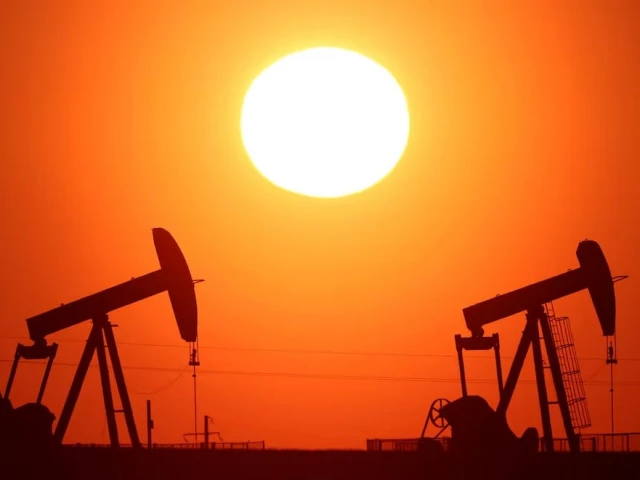
Oil prices fell on Thursday after rising about 4% in the previous session, as Iran signalled that it remained open to diplomatic efforts to end its conflict with the United States, although the two sides remain divided over the terms of any agreement.
Brent crude futures fell 92 cents, or 0.9%, to $102.16 a barrel at 0900 PKT, while US West Texas Intermediate (WTI) futures declined 77 cents, or 0.8%, to $91.39.
An Iranian senior official told Reuters on Wednesday that Tehran and Washington remained far apart on how to end the conflict but said diplomatic efforts should continue. The comments followed an address by Iran’s president to the UN General Assembly, where he said Tehran would not yield to US pressure.
The Iranian official said Tehran was reviewing Washington’s response to its proposals for ending the conflict. Iran has prioritised the lifting of a US naval blockade on its ports and the reopening of the Strait of Hormuz, a major global oil shipping route.
“Oil is falling because the market is unwinding part of its geopolitical risk premium as Gulf supply recovers and hopes of a US-Iran diplomatic breakthrough grow,” said Priyanka Sachdeva, head of market insights at Phillip Nova.
KSE-100 Falls as Investors Take Profit After Four-Day Rally
Sachdeva said Brent crude continues to carry a larger geopolitical and shipping-route premium because international oil supplies are more exposed to disruptions in the Middle East and the Strait of Hormuz, while US crude benefits from comparatively insulated domestic production.
Earlier on Wednesday, Iranian security chief Mohsen Rezaei said the Strait of Hormuz would remain closed until Iran’s conditions were met.
US Secretary of State Marco Rubio said a potential agreement with Iran would require sustained negotiations. He also said President Donald Trump retained military options.
Markets were also watching reports about possible restrictions on US diesel exports. Ultra-low-sulfur diesel futures fell about 5% in midday trading after Politico reported that the Trump administration was preparing a possible 90-day diesel export ban. The White House denied the report.
US Energy Secretary Chris Wright had earlier said a diesel export ban would not be effective, despite Trump saying he would support such a measure.
Analysts and market participants have warned that restricting diesel exports could have limited impact on domestic energy prices while potentially tightening global supplies and adding pressure to economies dependent on fuel imports.
US distillate inventories, including diesel and heating oil, fell by 428,000 barrels last week to 107.4 million barrels, according to data from the Energy Information Administration.
US crude inventories, meanwhile, increased by 3 million barrels to 426.4 million barrels. Analysts polled by Reuters had expected inventories to decline by about 641,000 barrels.