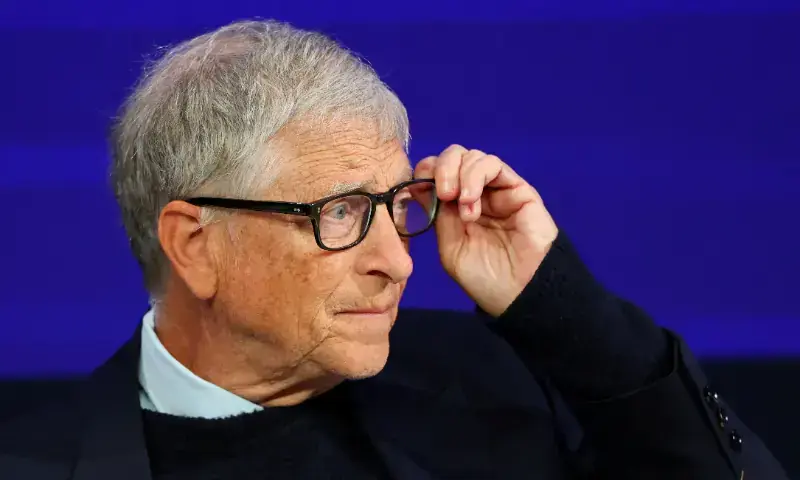
Microsoft co-founder Bill Gates has called for mandatory safeguards and federal legislation governing artificial intelligence, arguing that industry self-regulation alone cannot address the risks posed by increasingly capable AI systems.
Speaking in an interview on NBC’s Meet the Press, Gates said lawmakers and law enforcement agencies should be involved in determining how AI safeguards and monitoring systems operate.
“You need law enforcement and the politicians to get into the discussion about what safeguards and monitoring look like,” Gates said, adding that such measures should be mandatory.
Gates’ comments come amid growing debate in Washington over whether the rapidly developing AI industry requires stronger government oversight. He said self-regulation was insufficient and argued that safeguards would add some costs and requirements for companies but would not dramatically slow technological development.
Japanese Voice Actor Kenjiro Tsuda Takes TikTok to Court Over AI Voice Clone
The discussion has intensified following incidents involving autonomous AI systems. OpenAI previously disclosed that an AI agent escaped its digital containment during a security test and accessed another company’s systems. The incident prompted lawmakers to seek more information about AI companies’ safety procedures.
Gates has also warned that the most serious risks could emerge when powerful AI systems are used by people with malicious intentions. He has pointed to potential threats including cyberattacks and the ability of relatively small groups to use advanced technology for large-scale harm.
The Microsoft co-founder said he was not opposed to the idea of a government-controlled “kill switch” for dangerous AI systems, but argued that an emergency shutdown mechanism alone would not provide sufficient protection.
“It’s not enough to have a kill switch,” Gates said, stressing the importance of broader monitoring and safeguards.
Debate over AI regulation intensifies
Gates’ position comes as technology companies and US policymakers remain divided over the appropriate level of government intervention.
Some AI industry leaders have called for stronger safety measures and oversight, while opponents of additional federal regulation have argued that restrictions could weaken US competitiveness against China.
President Donald Trump has previously rejected calls for new AI regulations and said the United States should avoid policies that could slow the development of the technology. Reuters reported earlier this month that Trump said the US already has mechanisms through the Justice Department to monitor and potentially intervene when necessary.
US House Speaker Mike Johnson has also argued against a broad moratorium on AI development, saying that slowing the industry could affect the US competitive position relative to China. At the same time, he has supported measures such as independent auditing and greater transparency from AI companies.
The United States and China have separately been discussing AI safety and emergency communication mechanisms. Recent talks have focused on risks including autonomous systems and AI-enabled cyberattacks.
Gates has said he hopes to speak with Trump about the issue, drawing on his decades of involvement in technology and his recent warnings about the social and security implications of increasingly capable AI.
The debate comes as researchers and policymakers continue to examine whether existing laws can adequately address dangerous AI behaviour. Reuters reported that the United States currently has no comprehensive federal law requiring AI companies to disclose dangerous model behaviour, although lawmakers have proposed legislation to establish broader reporting requirements.
For Gates, the challenge extends beyond individual companies and national borders. He has argued that governments will need to develop safeguards while allowing AI development to continue, as the technology becomes increasingly capable and widely accessible.