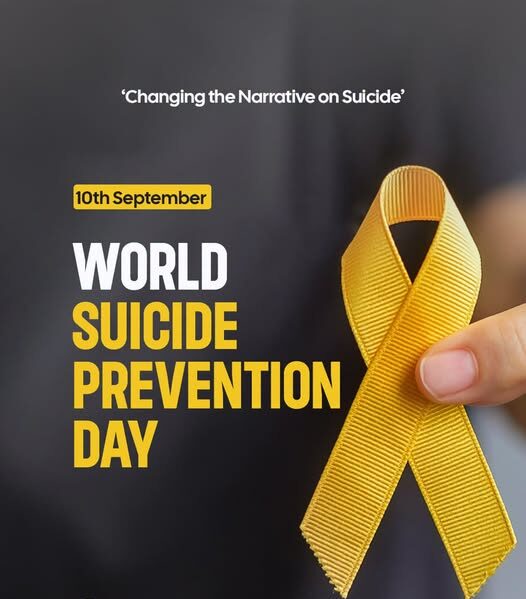
Every year, 10 September is observed as World Suicide Prevention Day. The day draws attention to one of the world’s most painful and neglected public-health challenges.
The theme for 2024–2026 is “Changing the Narrative on Suicide.” In 2026, the call is “Start the Conversation.”
The message is clear. Suicide must not remain surrounded by silence, shame and stigma. Society must discuss it openly, compassionately and responsibly.
Understanding Suicide
Suicide is the intentional ending of one’s own life. Yet it should not be viewed simply as an individual decision or the result of one particular problem.
In many cases, suicide reflects a complex interaction of psychological, social, family, economic, cultural and environmental factors.
The World Health Organization estimates that more than 720,000 people die by suicide every year worldwide. In 2021, an estimated 727,000 people died by suicide.
Suicide was the third leading cause of death among people aged 15 to 29. About 73% of suicides occurred in low- and middle-income countries.
For every suicide, there are many more attempts.
This makes suicide more than a mental-health issue. It is also a public-health, social and economic challenge. Governments, healthcare institutions, schools, families, communities and civil-society organisations all have a role in prevention.
Psychological Factors
Mental-health difficulties can significantly increase suicide risk.
Depression, severe anxiety, substance-use disorders, trauma and loneliness can make people feel that their suffering has no solution.
However, it is important to avoid the misconception that everyone who dies by suicide has a diagnosed mental illness.
Many suicides occur during periods of acute crisis. At such moments, a person may temporarily lose the ability to cope with overwhelming stress.
Relationship problems, financial difficulties, chronic illness, violence, abuse, loss and isolation can also contribute to suicidal thoughts.
Early identification is therefore essential.
A person in distress needs someone who will listen without judgment. They also need access to appropriate professional and social support.
Social Pressures Can Increase Vulnerability
Social conditions can create enormous psychological pressure.
Domestic violence, forced or unhappy marriages, family conflict, discrimination, unemployment, lack of education and social isolation can all increase vulnerability.
The breakdown of traditional support networks can make these pressures even harder to manage.
Young people face particular challenges. Academic pressure, unemployment, relationship problems and social expectations can contribute to feelings of hopelessness.
Women experiencing domestic violence or restrictions on their choices may also feel trapped when safe support systems are unavailable.
The response should never be to blame the victim.
Instead, society must create an environment where seeking psychological help is seen as an act of courage rather than a source of shame.
Poverty and Economic Insecurity
Economic hardship can also contribute to despair.
Unemployment, debt, loss of livelihood, food insecurity, healthcare expenses and the inability to provide for a family can create severe psychological stress.
This connection is especially important in rural and drought-affected communities.
In Tharparkar, previous reporting has linked economic hardship, declining agricultural yields, livestock losses and drought with increased vulnerability to suicide.
Economic hardship does not automatically lead to suicide. However, when poverty combines with family conflict, isolation, inadequate healthcare and a lack of hope, the risks can become significantly greater.
Pakistan’s Suicide Data Remain Incomplete
Pakistan faces another major challenge: reliable national suicide statistics remain limited.
WHO country data lists Pakistan’s suicide mortality rate at 6.09 per 100,000 people for 2019. However, suicide data can be incomplete or under-reported because of stigma, misclassification and weaknesses in death-registration systems.
Available figures should therefore not be assumed to represent the full scale of the problem.
Pakistan needs a reliable national suicide-surveillance system.
Such a system should bring together information from hospitals, police records, death registration authorities and mental-health services.
Accurate data would help authorities identify high-risk communities. It would also allow them to measure whether prevention programmes are producing results.
Tharparkar Needs Urgent Attention
The situation in Tharparkar deserves particular attention.
Reports have repeatedly identified the district as having a high number of reported suicides relative to its population.
According to Tharparkar police figures reported by Dawn, 129 suicides were recorded in 2022, compared with 121 in 2021.
Of the 129 reported deaths in 2022, 70 involved females and 59 involved males.
Reports have highlighted domestic violence, unhappy marriages, poverty, social isolation and weakened community support as important factors.
Earlier studies have also identified drought, poverty, loss of agricultural livelihoods and livestock losses as contributing pressures.
A psychological-autopsy study in Tharparkar found financial constraints, chronic physical or mental-health problems and social difficulties among factors reported in the cases studied. Notably, 48% of those cases involved teenagers.
More recent research involving more than 5,000 Tharparkar residents has continued to highlight mental-health problems and a lack of awareness.
Experts have also pointed to the stigma surrounding mental illness.
These findings show that Tharparkar needs a dedicated suicide-prevention strategy. Such a programme must reflect the district’s geographical, economic, cultural and healthcare realities.
Questions for the Sindh Government
The continuing crisis also raises serious questions about the performance of the Sindh Government.
Establishing institutions alone is not enough.
People in Tharparkar need functioning mental-health services, trained professionals, emergency support, reliable data and continuous community-based prevention.
A 2023 report noted that despite the establishment of the Sindh Mental Health Authority, Tharparkar had only one psychiatrist serving the vast district. Police records were also described as inconsistent, with some cases poorly investigated or classified.
This points to a broader failure of healthcare and governance.
The Sindh Government should treat suicide prevention as a long-term public-health priority. Occasional seminars after another tragedy cannot replace sustained action.
A Ten-Point Prevention Plan
1. Establish a district suicide-prevention programme.
Sindh should launch a dedicated programme in Tharparkar with specific funding, measurable targets and regular monitoring.
2. Expand mental-health services.
Major hospitals and rural health facilities should have trained psychologists, psychiatrists or mental-health counsellors. Tele-psychiatry can help connect remote communities with specialists.
3. Support students.
Schools and colleges should provide mental-health awareness, emotional-life skills and confidential counselling.
4. Create a 24-hour crisis helpline.
A national or provincial suicide and mental-health helpline should connect people in crisis with trained professionals and emergency services.
5. Improve data collection.
Hospitals, police, death-registration authorities and public-health departments should collect accurate information while protecting families’ privacy.
6. Address violence against women.
Prevention programmes must address domestic violence, forced marriages, child marriage and other forms of violence against women.
7. Reduce economic vulnerability.
Programmes in Tharparkar must address poverty, drought, water shortages, food insecurity, livestock losses and unemployment.
Suicide prevention cannot succeed while people remain trapped in extreme economic insecurity.
8. Restrict access to highly lethal means.
Highly hazardous pesticides and other readily accessible lethal means should be safely stored and appropriately regulated. Restricting access to lethal means is recognised by WHO as an evidence-based suicide-prevention measure.
9. Promote responsible media reporting.
Media organisations should avoid sensationalism, speculation and unnecessary details about suicide methods. Responsible reporting can help reduce harm.
10. Train community leaders.
Religious leaders, teachers, doctors, community leaders, NGOs and civil-society organisations should be trained to recognise warning signs and guide vulnerable people towards professional help.
Prevention Must Become a Priority
Suicide is not a sign of weakness.
It can be a sign that unbearable suffering has overwhelmed a person’s ability to cope.
Society must replace silence with conversation. It must replace stigma with compassion, neglect with treatment and despair with hope.
The people of Tharparkar deserve the same access to mental healthcare and social protection as every other citizen of Pakistan.
Every life lost is more than a statistic. It is a parent, child, brother, sister, husband, wife or friend whose absence leaves a permanent wound.
On World Suicide Prevention Day, 10 September 2026, let us start the conversation.
The Sindh Government must act before another life is lost.
Suicide is preventable. Prevention must become a public-health priority.
Dr Jaipal Chhabria
Committee Against Human Rights Violation
Pakistan Tehreek-e-Insaf, Sindh