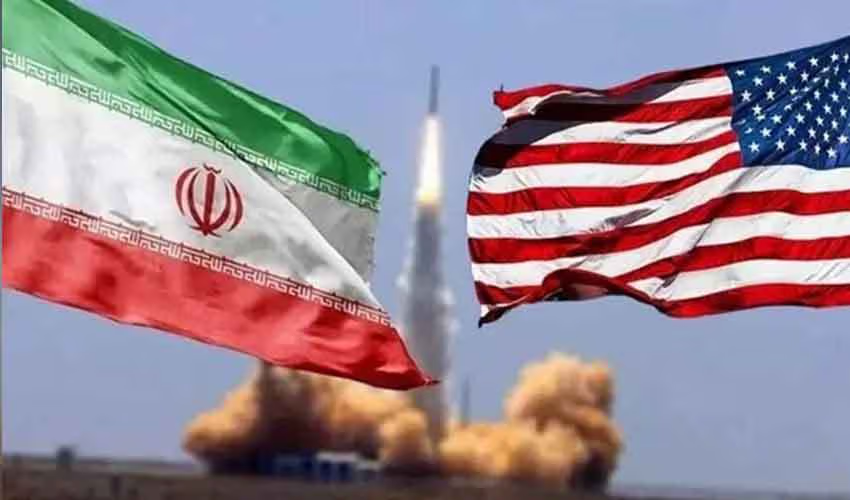
The US-Iran confrontation has intensified after Iranian Foreign Minister Abbas Araghchi rejected Washington’s latest economic threats and said previous sanctions campaigns had failed to achieve their goals.
Araghchi responded after US President Donald Trump warned that countries providing support to Iran would face what he described as devastating economic consequences.
Iran dismisses new US pressure
Araghchi said Washington imposed what it called its most destructive sanctions against Iran 14 years ago but failed to achieve its objectives. He added that another major pressure campaign launched eight years ago also produced no results.
The Iranian foreign minister said the latest US measures would similarly fail.
He also recalled that Washington demanded Iran’s unconditional surrender five months ago. According to Araghchi, Tehran rejected that demand and continued to resist US pressure.
Iranian Foreign Ministry spokesman Esmail Baqaei separately criticised the new sanctions. He argued that Washington had no right to force banks and companies in other countries to abandon legitimate trade with Iran.
Washington threatens trading partners
US Treasury Secretary Scott Bessent said the administration would announce details of the new sanctions on Monday.
Trump has warned that any country providing “any type of lifeline to Iran” could face economic consequences. Bessent also promised what he described as the toughest financial penalties in US history.
During an interview with CNBC, Bessent said the administration intended to put severe pressure on Iran’s leadership.
TikTok: US Government Reaches $400 Million Settlement Over Children’s Privacy
Tehran warns of retaliation
Iranian military officials have responded with warnings of a major retaliation if Washington escalates its pressure.
Chief of Staff of Iran’s Armed Forces Major General Ali Abdollahi said Iranian forces remained prepared across land, sea, air, air defence and cyberspace.
He warned that Iran would respond to new threats with what he described as “crushing, punishing and devastating responses.”
Iranian Navy Commander Shahram Irani also warned about developments around the Strait of Hormuz. He claimed Iranian forces maintain control over the eastern part of the strategic waterway and key areas of the Gulf of Oman.
Economic pressure adds to tensions
The confrontation has placed further pressure on Iran’s already strained economy. The country has faced extensive US sanctions for decades, contributing to inflation, currency weakness, energy shortages and infrastructure problems.
Iranian Parliament Speaker Mohammad Baqer Qalibaf acknowledged the economic challenge, saying military strength alone could not sustain the country if people faced hunger and economic activity remained weak.
Meanwhile, tighter sanctions on Iranian oil could affect global energy supplies and push prices higher.
China faces pressure over Iranian oil
China has also emerged as a key factor in the sanctions dispute because it remains a major buyer of Iranian oil.
Bessent has urged Beijing to cooperate with Washington, pointing to China’s reliance on energy supplies from the Gulf. However, additional US pressure on China could trigger a broader economic response between the two major powers.
China’s embassy in Washington has rejected the use of sanctions and pressure as a way to resolve the crisis and called for diplomacy instead.
Strait of Hormuz remains a major flashpoint
The Strait of Hormuz remains at the centre of the wider confrontation because it carries a significant share of global oil shipments.
Any prolonged disruption could affect energy markets, shipping and economies far beyond the Middle East. Gulf states also face risks because attacks on energy facilities and desalination plants could threaten both economic activity and essential services.
At the same time, Iran and Oman have held separate discussions on restoring navigation through the strait. Washington, however, has opposed proposals that would impose tolls on ships.
Allies discuss freedom of navigation
NATO’s top commander, US Air Force General Alexus Grynkewich, recently convened a videoconference with allied defence chiefs to discuss support for freedom of navigation in the Strait of Hormuz.
A spokesperson said the discussions did not represent a NATO mission. However, the alliance could help coordinate efforts among member states because of its military capabilities.
With Washington preparing additional sanctions and Tehran warning of retaliation, the Strait of Hormuz remains a key pressure point in the escalating US-Iran confrontation.