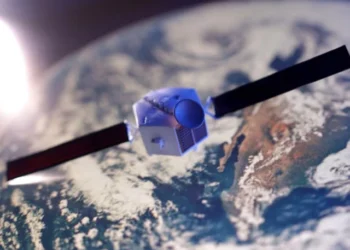
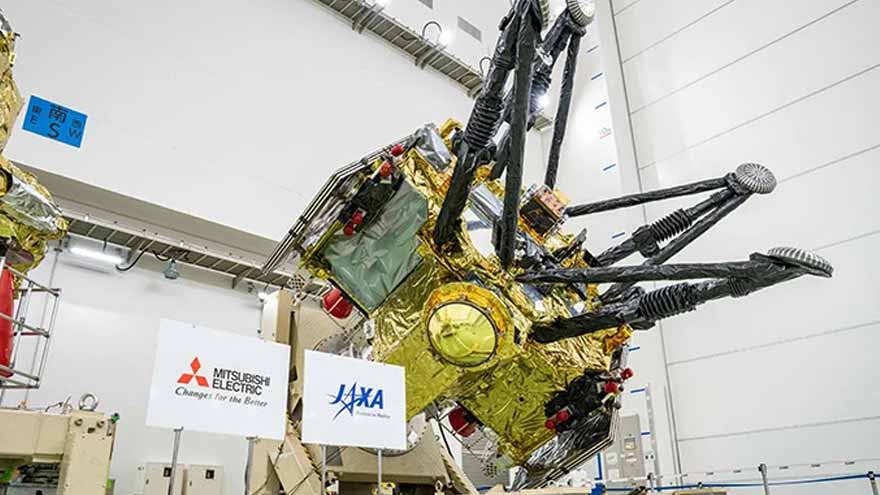
Japan is preparing to launch a major mission to Mars that could help scientists understand how the Solar System formed and how the conditions for life emerged on Earth.
The Japan Aerospace Exploration Agency (JAXA) plans to launch its Martian Moons eXploration (MMX) spacecraft from the Tanegashima Space Center in the coming months.
The unmanned spacecraft will spend about three years around Mars. It will attempt to land on Phobos, collect at least 10 grams of material and return the samples to Earth.
A return capsule will eventually land in Australia, with the sample delivery expected around 2031.
Mission Will Explore Phobos and Deimos
MMX will deploy the IDEFIX rover, developed with French partners, to study the surface of Phobos.
The spacecraft will also observe Deimos, Mars’ second moon. However, it will not attempt to land there.
Liverpool Van Dijk Says New Defence Needs Time to Build Understanding
Scientists hope the mission will determine how Mars and its two moons formed. The findings could also help explain how the Solar System developed billions of years ago.
Two Theories About Mars’ Moons
Scientists currently consider two major explanations for the origins of Phobos and Deimos.
The giant impact hypothesis suggests that the moons formed from material thrown into space after another celestial body collided with Mars.
The capture hypothesis, meanwhile, suggests that the moons are asteroids from the outer Solar System that Mars later captured with its gravity.
Determining which theory is correct could provide important clues about how water, organic compounds and other materials reached the inner Solar System.
JAXA says MMX could help scientists understand the processes that may have made rocky planets such as Mercury, Venus, Earth and Mars habitable.
French astrophysicist Patrick Michel, who works on the IDEFIX project, said Phobos and Deimos could preserve evidence about how materials travelled from the outer Solar System to the inner planetary region.
If the moons contain remnants of those early materials, they could offer clues about the ingredients that contributed to the emergence of life.
Preparing for Human Mars Missions
The mission could also support future human exploration.
JAXA plans to investigate whether Phobos could serve as a natural space station for future Mars missions.
The agency says developing technology for a round trip to Mars will form an important foundation for eventual crewed exploration.
Difficult Landing on Phobos
Landing on Phobos presents a major engineering challenge because the moon has extremely weak gravity.
Akinari Uehara, an engineer at Mitsubishi Electric, said the spacecraft’s landing legs must absorb the impact while preventing the probe from tipping or drifting away.
Japan has already gained experience with difficult planetary landings. Its Smart Lander for Investigating Moon (SLIM), known as the “Moon Sniper”, tipped over after landing on the Moon in 2024.
Despite the problem, SLIM continued transmitting data and survived several lunar nights.
Japan also has extensive experience with sample-return missions. JAXA’s Hayabusa-2 spacecraft returned 5.4 grams of rock and dust from the asteroid Ryugu in 2020.
China Also Targets Mars Samples
Japan is not the only country pursuing Mars-related sample research.
NASA’s Perseverance rover has collected samples on Mars since landing in 2021. Those samples could eventually return to Earth, although the original US sample-return programme has faced major changes and uncertainty.
China is also preparing the Tianwen-3 mission. Beijing plans to launch the spacecraft around 2028 and return Mars samples to Earth around 2031.
That timeline could allow China to return samples before MMX brings material from Phobos back to Earth.
China has already achieved a major milestone in Mars exploration. Its Tianwen-1 mission successfully placed the Zhurong rover on Mars in 2021.
The competition between Japan and China adds another dimension to the growing international effort to explore Mars and its moons. While the missions have different objectives, their findings could significantly improve scientific understanding of the Solar System and the conditions that made life possible on Earth.