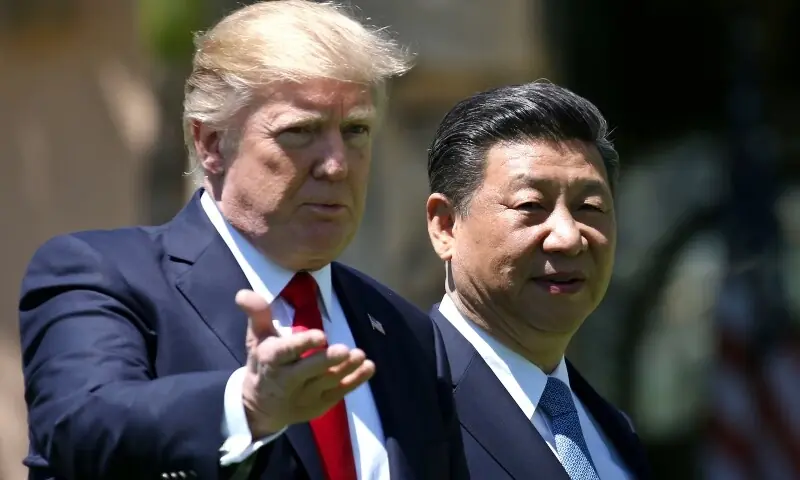
BEIJING: US President Donald Trump said on Wednesday that he would urge Chinese President Xi Jinping to further open China’s economy to American companies as he arrived in Beijing for a major summit expected to focus on trade, technology, Taiwan, and the ongoing conflict in the Middle East.
In a social media post after departing Washington, Trump praised Xi as “a Leader of extraordinary distinction” and said he intended to encourage greater access for US businesses in China.
“I will be asking President Xi to ‘open up’ China so that these brilliant people can work their magic and help bring the People’s Republic to an even higher level,” Trump wrote.
The high-profile visit, the first by a US president to China in nearly a decade, has attracted several leading American business executives. Among those travelling with Trump were Jensen Huang, chief executive of NVIDIA, and Elon Musk of Tesla. Reports also indicated that Tim Cook from Apple and other top corporate leaders would participate in meetings during the Beijing visit.
While trade and investment remain central to the summit, the discussions are also expected to address rising geopolitical tensions, including the Iran conflict, Taiwan, artificial intelligence competition, and rare earth exports.
Speaking before leaving the White House, Trump said he expected to have a “long talk” with Xi regarding Iran, noting that China remains a major buyer of Iranian oil despite US sanctions.
However, Trump attempted to downplay differences with Beijing over the issue, saying Xi had been “relatively good” regarding Iran and adding, “I don’t think we need any help with Iran.”
Meanwhile, China has increasingly pushed for diplomatic solutions in the region. Chinese officials recently urged Pakistan to support mediation efforts between Iran and the United States.
The summit, scheduled for Thursday and Friday, is expected to feature extensive ceremonial events, including a state banquet at Beijing’s Great Hall of the People and formal diplomatic receptions.
One of the most closely watched topics will be Taiwan. Trump stated earlier this week that he planned to discuss US arms sales to Taiwan with Xi, marking a notable shift from longstanding US policy that traditionally avoided consulting Beijing directly on support for the self-governing island claimed by China.
Trade tensions are also likely to dominate the agenda. Both sides are expected to discuss extending the one-year tariff truce reached during Trump and Xi’s last meeting in South Korea in October.
Analysts say the summit comes at a delicate moment for both powers. Trump faces growing international scrutiny over Middle East tensions, while China continues to confront economic challenges, including sluggish domestic demand and a prolonged debt crisis in its property sector.
Security measures across Beijing were visibly tightened ahead of the visit, with police monitoring key intersections and conducting identification checks at metro stations.
Residents in the Chinese capital described the summit as highly significant for global stability and economic cooperation.
“It’s definitely a big deal,” said one Beijing visitor, expressing hope that the two countries could help ensure “lasting peace” amid increasing global uncertainty.
Despite ongoing rivalry in trade and geopolitics, both Washington and Beijing continue efforts to stabilize bilateral ties. Trump has repeatedly highlighted his personal relationship with Xi, saying he believed it could help prevent conflict over Taiwan.
“I think we’ll be fine. I have a very good relationship with President Xi. He knows I don’t want that to happen,” Trump said.
The outcome of the summit will be closely watched by Asian allies, international investors, and global markets for signs of future US-China cooperation or renewed tensions between the world’s two largest economies.