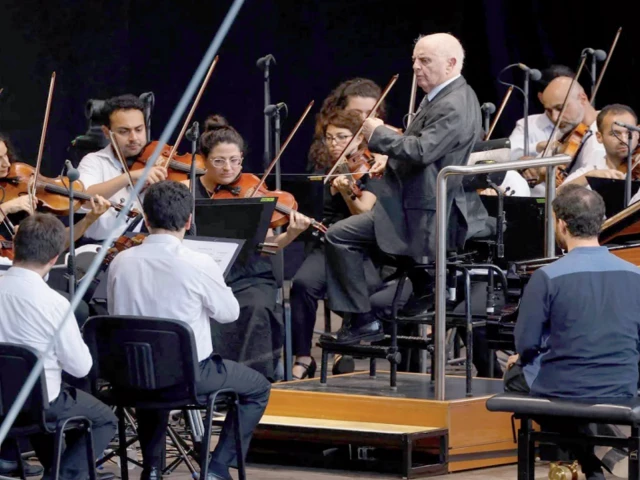
More than 25 years after its founding, the West-Eastern Divan Orchestra continues to promote dialogue between Israelis and Palestinians through music, with its members maintaining conversations despite growing political tensions in the Middle East.
“Our message of peace must be louder than ever,” renowned conductor Daniel Barenboim told AFP ahead of a week-long festival in Berlin celebrating the orchestra and its work.
The 83-year-old musician founded the ensemble in 1999 alongside Palestinian-American intellectual Edward Said. The festival aims to introduce the organisation’s work to an even wider audience, Barenboim said in an email interview.
The West-Eastern Divan Orchestra brings together around 100 musicians from Israel, the Palestinian Territories and Arab countries. Its mission is to encourage mutual understanding through a shared commitment to classical music.
However, differences in the musicians’ backgrounds and political views have made relationships within the orchestra complex, particularly following the Hamas-led October 7, 2023 attacks on Israel and the subsequent war in Gaza.
Music Creates Common Ground
Israeli violist Tal Riva Theodorou said initial conversations among musicians were sometimes difficult and inflammatory.
The 44-year-old, who has been part of the orchestra since 2004, said spending time together had helped members understand one another and develop closer relationships.
Indonesia Vice President Gibran Resigns as Jokowi Reaffirms Support for Prabowo
Palestinian double bassist Fadwa Qamhia also described the orchestra’s tours as opportunities for dialogue.
The 31-year-old, who comes from the occupied West Bank, said travelling together for long periods created opportunities for conversations that might not otherwise take place.
She explained that sharing everyday experiences allowed musicians to listen to one another and recognise their common humanity.
Theodorou said performing together and creating music helped establish common ground despite political differences.
“I think that’s the power of music,” she said.
Palestinian Musician Describes Orchestra as an Exercise in Freedom
Born in Nablus in 1995, shortly after the Oslo Accords, Qamhia grew up experiencing military checkpoints and the realities of occupation.
She said joining the orchestra gave her a different kind of power: the freedom to participate as a human being without the restrictions she experiences in her homeland.
Qamhia described the orchestra as an opportunity to exercise humanity and freedom, adding that she wanted similar opportunities for the Palestinian people.
She also spoke about her relationship with Barenboim, saying the conductor regarded many orchestra members as his sons and daughters.
“He feels a lot of pain for us because we are almost like his sons and daughters,” she said.
Qamhia added that Barenboim felt deeply affected by the lack of progress towards peace between Israelis and Palestinians.
Barenboim Calls for Peace Amid Regional Tensions
Ahead of the Berlin festival, Barenboim attended a rehearsal in the German capital. He previously served as general music director of the Berlin State Opera for several decades.
The conductor, who publicly confirmed his Parkinson’s disease diagnosis in 2025, said extremists and violence risk drowning out people who continue to call for peace.
“The greatest danger is that all the people who so fervently long for peace are drowned out by extremists and violence,” he wrote.
He also expressed his conviction that Israelis and Palestinians share a common destiny.
Barenboim holds Spanish, Israeli and Palestinian citizenship. He served as general music director of the Berlin State Opera and Staatskapellmeister of the Staatskapelle Berlin from 1992 until January 2023.
Throughout his career, he has received numerous international honours, including seven Grammy Awards, France’s Legion of Honour and Germany’s Grand Cross of the Order of Merit.
Alongside his musical career, Barenboim has been a prominent advocate of dialogue between Israelis and Palestinians and a critic of Israel’s occupation of Palestinian territories.
More than two decades after its establishment, the West-Eastern Divan Orchestra continues to use music as a shared platform for musicians whose communities remain divided by conflict.