Arbab Khan
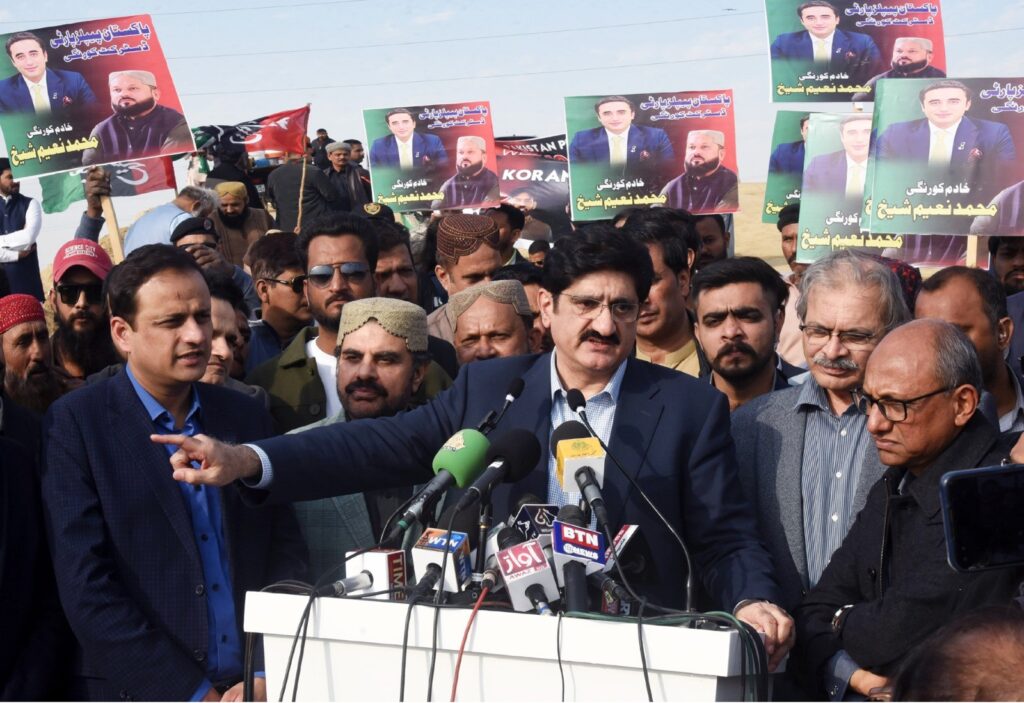
Karachi: Sindh Chief Minister Syed Murad Ali Shah on Monday inaugurated the Rs6.1 billion Korangi Causeway Bridge, describing it as a key milestone in Karachi’s infrastructure development, while also detailing wide-ranging relief, rehabilitation and reconstruction measures for victims of the recent Gul Plaza fire tragedy.
Speaking to the media at the inauguration ceremony, the chief minister began by offering prayers for those who lost their lives in the Gul Plaza incident and urged attendees to recite Surah Al-Fatiha and Surah Al-Ikhlas for the departed souls. He said the tragedy had deeply saddened the province and reiterated that no compensation could ever truly offset the loss of human life.
The chief minister, accompanied by Provincial Minister for Local Government Syed Nasir Shah, Provincial Minister for Labour Saeed Ghani and Mayor Karachi Murtaza Wahab, said the Korangi Causeway project was a long-standing commitment to residents and industrial stakeholders of Korangi and surrounding areas.
“This area used to be cut off whenever it rained, effectively dividing the city into two parts. Nearly three years ago, we committed to building a bridge here to resolve this problem,” he said.
Murad Ali Shah said construction began around one and a half years ago but faced delays due to design issues. The newly inaugurated bridge is approximately 1.4 kilometres long, comprises six lanes, and has been built at a cost of over Rs6.135 billion.
He said the bridge would significantly benefit the Korangi and Landhi industrial zones, daily commuters and nearby facilities, including Indus Hospital, SIUT, educational institutions and residential neighbourhoods. Nearly five million people are expected to use the bridge daily.
The chief minister added that the project is part of a broader initiative to rehabilitate Karachi’s infrastructure. He said work was continuing to connect Shahrah-e-Bhutto with Korangi Road, expressing confidence that the corridor would be opened by Eid or shortly after, linking Korangi Road to the M-9 Motorway.
He was also briefed on the grade-separated interchanges and connecting loops under the Shaheed Bhutto Expressway project, which will link Korangi, DHA and the M-9 (Kathore) Highway. He said the expressway would serve as Karachi’s economic artery and help ease long-standing traffic congestion through controlled-access routes.
Relief package for Gul Plaza victims and traders
Turning to the Gul Plaza tragedy, Murad Ali Shah reiterated that the Sindh government had announced Rs10 million compensation for each deceased person’s family on the first day of the incident.
He said cabinet approval was being sought for a comprehensive support package for affected shopkeepers. Each shopkeeper will receive Rs500,000 in immediate subsistence support to meet household expenses over the next two months.
The chief minister said the government, in coordination with the Karachi Chamber of Commerce and Industry (KCCI), had begun assessing business losses and would compensate traders for destroyed goods and inventory. He added that several building owners had volunteered to provide temporary commercial space, and that approximately 1,300 affected shops would be relocated within two months.
He further announced that through the Sindh Enterprise Development Fund, each affected shopkeeper would be offered an interest-free loan of up to Rs10 million, with the provincial government acting as guarantor and bearing the markup.
Reconstruction and accountability
Murad Ali Shah said Gul Plaza would be demolished and reconstructed with a revised, safety-focused design. Corridors would be widened to improve evacuation and emergency access, and there would be no increase in the number of shops in the rebuilt structure.
An inquiry into the incident is under way and an FIR has already been registered. “Whoever is found responsible through the inquiry will be punished,” he said.
Citywide fire safety drive
The chief minister acknowledged institutional shortcomings and said building fire safety audits had begun, including surveys of high-occupancy commercial structures. He said owners would be given short deadlines to install essential safety measures, including fire alarms, portable firefighting equipment, marked emergency exits, clear evacuation routes and backup lighting.
He warned that non-compliant buildings would be sealed if deficiencies were not addressed. Within six months, he said, all commercial buildings would be required to fully comply with fire and disaster safety regulations.
Calling for collective responsibility, Murad Ali Shah urged traders, chambers, associations, industrialists and building owners to cooperate with the government to prevent future tragedies.
He concluded by saying that Gul Plaza would be rebuilt in consultation with affected shopkeepers and that transparency and safety would remain central to the reconstruction process.