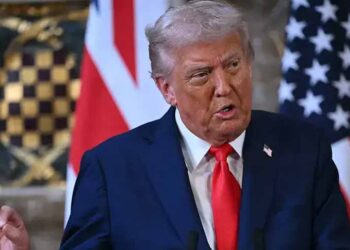

Global oil prices surged sharply to $122 on early Thursday morning (Pakistan Standard Time) after the United States President Donald Trump refused to budge on a prolonged blockade of Iranian ports.
The unexpected exit of the United Arab Emirates from OPEC and OPEC+ alliances has also played a big role in oil rates spiking above $120 in the past 24 hours.
Brent crude climbed above $120 per barrel, briefly touching $122 a short while ago. This is its highest level since 2022.
Market sentiment shifted after senior energy executives met US leadership in Washington to assess the economic impact of the ongoing Iran war and rising fuel costs.
Commentators on X have interpreted these discussions as confirmation that restrictions on Iranian exports and maritime traffic could persist for an extended period.
Tensions around the Strait of Hormuz also continue to disrupt energy logistics. The strategic waterway normally handles roughly one-fifth of worldwide oil and liquefied natural gas shipments, so the current interruption is substantially hurting international markets.
Iran has restricted shipping movements through the Strait following military escalation by the US navy earlier this year.
So far, US forces have moved to intercept vessels linked to Iranian ports. The standoff has effectively reduced available oil supply and pushed prices steadily higher over the past two weeks.
Overall, oil markets have experienced extreme volatility since the war began. Prices briefly eased earlier in April amid ceasefire expectations after talks in Islamabad but quickly reversed course as negotiations stalled and blockade risks intensified.
A prolonged disruption in Hormuz could tighten global inventories further and raise the possibility of much worse economic fallout if energy flows stay as they are today.