South Korean President Lee Jae Myung has urged North Korea to restore trust and resume dialogue, despite rising tensions over a recent landmine blast in the Demilitarized Zone (DMZ).
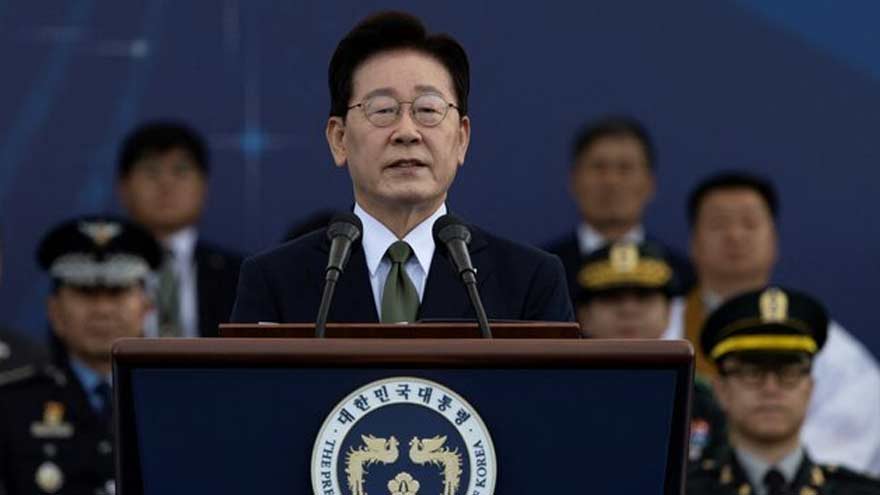
Speaking during South Korea’s Armed Forces Day ceremony, Lee said his government would continue pursuing practical measures to reduce military tensions between the two Koreas. He also called on Pyongyang to return to dialogue after a prolonged interruption.
Seoul and Pyongyang Clash Over DMZ Blast
Lee’s appeal came a day after South Korea’s military and the UN Command said mines believed to have been planted by North Korea violated the Korean War armistice.
The explosions on September 21 injured three South Korean soldiers near the military demarcation line in the western DMZ. A joint investigation by South Korean forces and the UN Command concluded that the mines were of North Korean origin.
UK Says Iran Played Role in Suspected RAF Fairford Plot
North Korea has rejected the findings.
Kim Yo Jong, the sister of North Korean leader Kim Jong Un, accused Seoul of fabricating the investigation and warned of retaliation if South Korean forces attack North Korean troops working on border fortifications.
The UN Command said the incident amounted to a violation of the 1953 armistice agreement, which governs military activity in and around the DMZ.
Lee Calls for Renewed Dialogue
Despite the dispute, Lee said Seoul would continue efforts to reduce tensions.
“I hope that the North joins us now on the path of restoring trust and resuming dialogue, following a long interruption,” Lee said.
He said trust between the two Koreas would require words to be matched by actions. Lee also described peace as an important element of national security and called for the two sides to find ways to build confidence.
North Korea has largely rejected recent overtures from Seoul. Pyongyang has also continued strengthening border positions along the DMZ, adding to tensions on the Korean Peninsula.
South Korea Plans Defence Modernisation
Alongside his call for dialogue, Lee outlined a broad defence modernisation programme.
He reaffirmed his goal of transferring wartime operational control of South Korean forces from the United States to Seoul. Lee has described the move as part of a broader effort to strengthen South Korea’s independent defence capabilities.
Lee also said South Korea plans to build nuclear-powered submarines by the mid-2030s.
The country will further develop missile defence systems, including artificial intelligence-based command-and-control technology and high-energy laser interceptors.
The modernisation plan also includes wider use of artificial intelligence, restructuring the military for future warfare and strengthening South Korea’s three-axis defence system for detecting and intercepting missile threats.
Tensions Remain High
Lee’s speech combined calls for engagement with plans to strengthen South Korea’s military capabilities.
The latest landmine dispute has added another point of tension between Seoul and Pyongyang. North Korea has rejected the investigation into the blast, while South Korea and the UN Command have maintained their assessment of the incident.
For now, Lee’s government is continuing to push for dialogue while preparing to strengthen the country’s defence capabilities amid persistent tensions with North Korea.