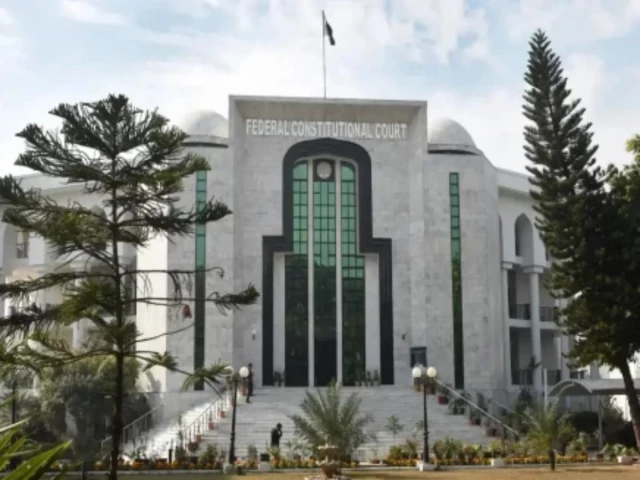
The newly notified rules of Pakistan’s Federal Constitutional Court (FCC) give the chief justice authority to constitute benches, without creating a three-judge committee similar to the mechanism operating in the Supreme Court.
The Federal Constitutional Court (Practice and Procedure) Rules 2026 designate the chief justice as the authority for nominating judges to hear cases. The rules were notified on Thursday and are now available publicly.
Under the rules, every case, matter or appeal must be heard by a bench of at least two judges nominated by the chief justice. This includes appeals arising from judgments issued by high court division benches.
Chief Justice Controls Bench Formation
The rules also give the chief justice authority to determine how cases proceed when judges hearing a matter are equally divided.
In such cases, the matter can be placed before another judge in chambers or a larger bench. The decision on the forum rests with the chief justice.
Government, PTI Begin Talks as October 4 March Raises Political Tensions
The chief justice can also constitute a larger bench at any stage. The rules allow this where a case involves questions of importance, complexity or public significance.
The number of judges on such a bench will also be determined by the chief justice.
These provisions effectively retain the chief justice’s role as the “master of the roster” in the FCC.
The court had previously operated under the Supreme Court Rules 2025 as an interim framework. Those rules also required a minimum two-judge bench for FCC cases.
Different Model from Supreme Court
The arrangement differs from the Supreme Court’s practice and procedure framework.
The Supreme Court Practice and Procedure Act 2023 created a three-member committee headed by the chief justice to oversee the constitution of benches. The Supreme Court continues to operate under that framework.
The FCC rules instead place the authority directly with its chief justice.
The issue of bench formation has remained a significant subject of debate in Pakistan’s superior judiciary. Critics of unrestricted roster powers have previously raised concerns about the selection of benches and the potential for cases to be assigned to particular combinations of judges.
In February, a larger Islamabad High Court bench reaffirmed that its chief justice was the sole “master of the roster” under the applicable rules.
Lawyers Debate Checks on Powers
The FCC’s expanded constitutional role has prompted debate among lawyers about the scope of the chief justice’s powers.
The court now handles constitutional questions and matters involving the enforcement of fundamental rights under the framework introduced after the 27th Constitutional Amendment. The newly notified rules provide the procedural framework for exercising that jurisdiction.
Some lawyers argue that the concentration of bench-forming authority in one office requires additional institutional safeguards.
Lawyer Abdul Moiz Jaferii, however, has expressed a different view. He argued that the chief justice should have control over the roster under the FCC’s institutional structure.
The contrasting views reflect a broader debate over how the new constitutional court should balance administrative control, judicial independence and transparency.
FCC Faces Questions Over Public Perception
The FCC has also faced scrutiny over the public perception of its institutional independence.
Its judges were appointed after the establishment of the new constitutional court. Some lawyers have raised concerns because the federal government is expected to appear before the court in constitutional and politically sensitive matters.
The FCC has already taken up several cases involving political issues and PTI-linked matters.
Among them, the court sought records concerning a case related to PTI founder Imran Khan’s health. It also issued notices in a petition concerning the de-seating of Khyber Pakhtunkhwa Chief Minister Sohail Afridi.
The court has also sought a response from the K-P chief minister over remarks concerning the proposed “Rahae Force”.
In another case, the FCC restrained an Anti-Terrorism Court in Peshawar from proceeding with a K-P government petition seeking withdrawal of cases against PTI leaders, including Chief Minister Afridi.
FCC Has Seven Vacant Seats
The FCC is also operating below its sanctioned strength.
The court currently has seven serving judges, while its sanctioned strength is 13. The federal government allocated about Rs6 billion for the FCC in the 2026-27 budget.
The allocation includes funding for salaries, staff, allowances, repairs and maintenance.
The court was established in November 2025. It initially adopted the Supreme Court Rules 2025 until it developed its own procedural framework.
The FCC has since notified its own practice and procedure rules, establishing a formal framework for its constitutional jurisdiction and case management.