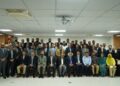
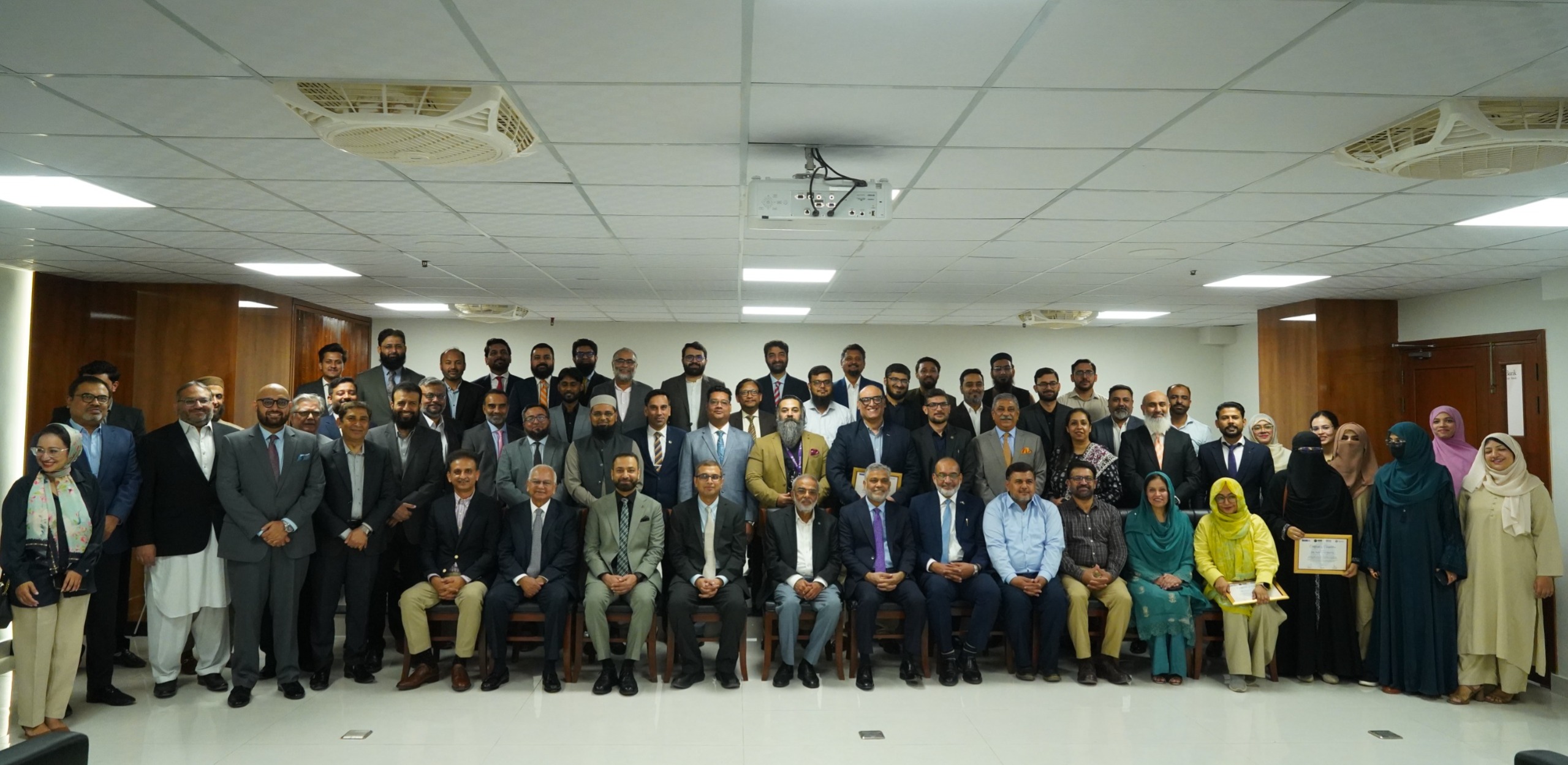
Forty bankers, financial professionals and academics received certificates on Saturday as Iqra University’s Centre for Excellence in Islamic FinTech (IU CEIF) graduated the first cohort of its postgraduate certification programme in Islamic FinTech and Digital Banking.
Established in strategic collaboration with Meezan Bank, IU CEIF aims to advance education, research, innovation and professional development in Islamic finance and financial technology. The Centre seeks to bridge the gap between academia and industry, promote Shariah-compliant financial innovation and contribute to Pakistan’s Islamic financial ecosystem.
The graduation ceremony took place at Iqra University’s Main Campus, with State Bank of Pakistan (SBP) Deputy Governor Saleem Ullah attending as the chief guest. Heads of several banks and financial institutions also attended the event.
Other prominent guests included Sindh Higher Education Commission (SHEC) Chairman Prof. Dr S. M. Tariq Rafi and Secretary Dr Noman Ahsan; CIEC Chairman Dr Sarosh Hashmat Lodhi; and Higher Education Commission officials Nasir Shah Mangri, Dr Amjad Hussain and Engr. Waheed Ahmed Mangi.
Addressing the ceremony, SBP Deputy Governor Saleem Ullah highlighted the growing role of Islamic banking in Pakistan’s financial sector.
“Islamic banking has almost a 31 per cent share in the deposits of the banking industry and about 26 per cent in terms of assets. Almost one-third of the industry is Islamic, and nearly 45 per cent of bank branches are Islamic,” he said.
New Uzbekistan Expands Constitutional Right to Social Security
He added that the ultimate objective was to establish a fair, just, equitable and transparent financial system that provides equal opportunities to all segments of society. He identified technological advancement as a major driver of this transformation.
Dr Syed Amir Ali, President of Meezan Bank and co-patron of IU CEIF, highlighted two major developments shaping Pakistan’s banking sector: the central bank’s direction to transform the banking industry towards Islamic banking and the growing accessibility of generative artificial intelligence.
Iqra University Vice Chancellor Dr Nassar Ikram said the future of Islamic FinTech required close cooperation between academics and industry professionals.
He emphasised the need to develop solutions that are academically sound, commercially viable, technologically resilient and compliant with Shariah principles.
Farhan ul Haq Usmani, Director of IU CEIF, said the programme aimed to bring Islamic finance and modern technology together while exploring practical ways to use emerging technologies to improve financial services.
He said the certification was designed to go beyond theoretical learning by bringing together subject experts, industry opinion leaders and experienced professionals who shared practical knowledge and real-world experiences.
The first graduating cohort marks a milestone in Iqra University’s efforts to develop professional expertise at the intersection of Islamic finance, digital banking and emerging technologies.