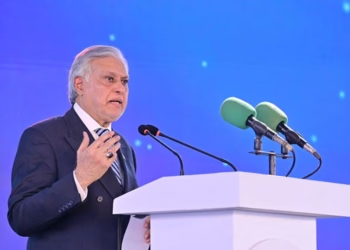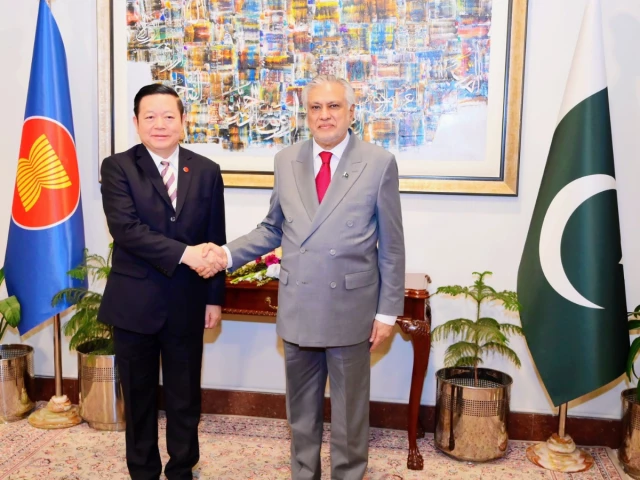
Deputy Prime Minister and Foreign Minister Ishaq Dar on Thursday reaffirmed Pakistan’s commitment to strengthening its longstanding partnership with the Association of Southeast Asian Nations (ASEAN), calling for expanded cooperation in trade, investment, education, research, regional connectivity and people-to-people exchanges.
Addressing delegation-level talks with ASEAN Secretary-General Dr Kao Kim Hourn, Dar said Pakistan highly valued its relationship with ASEAN and its individual member states. He emphasised the need to give the partnership greater practical substance through stronger engagement among businesses, universities and research institutions.
Founded in 1967, ASEAN has developed into a major regional economic and diplomatic bloc. Pakistan is seeking elevation from its existing Sector Dialogue Partnership to full Dialogue Partner status, although ASEAN currently has a moratorium on establishing new partnerships.
The Foreign Office had described the secretary-general’s visit as the first high-level visit to Pakistan by an ASEAN Secretariat delegation in more than two decades.
Dar said ASEAN’s nearly six decades of experience in bringing countries with diverse histories and economies closer together offered valuable lessons in regional integration, connectivity and collective cooperation.
Faysal Bank Wins Two Honours at Islamic Retail Banking Awards 2026
“In an increasingly fragmented world, ASEAN’s commitment to dialogue has particular significance,” he said, stressing the importance of collective efforts to promote peace, stability and shared prosperity.
Welcoming the secretary-general, Dar expressed confidence that the visit would deepen mutual understanding, strengthen existing areas of collaboration and create fresh opportunities for bilateral and regional engagement.
ASEAN welcomes Pakistan’s engagement
Dr Kao Kim Hourn appreciated Pakistan’s active engagement with ASEAN, particularly Dar’s participation in regional meetings and commemorative activities marking the 50th anniversary of the Treaty of Amity and Cooperation.
He said ASEAN attached considerable importance to its Sector Dialogue Partnership with Pakistan, established in 1993, and welcomed progress under the ASEAN-Pakistan Sector Dialogue Partnership Practical Cooperation Areas 2024–2028.
The ASEAN secretary-general highlighted opportunities to expand cooperation in trade and investment, private sector development, science and technology, innovation, cultural exchanges, human resource development, smart cities, and information and media cooperation.
He also identified potential areas for closer engagement in digital transformation, sustainable development, energy and food security, maritime security, cybersecurity, tourism, small and medium-sized enterprises, and humanitarian cooperation.
Dr Kao encouraged both sides to make full use of the existing cooperation framework to deliver tangible benefits for their people.
Referring to the 35th anniversary of the ASEAN-Pakistan Sector Dialogue Partnership in 2028, he expressed ASEAN’s readiness to work closely with Pakistan to further strengthen relations.
He also acknowledged Pakistan’s request for elevation to ASEAN Dialogue Partner status, saying the matter was under consideration in line with established ASEAN procedures.
Regional and international issues discussed
Discussing regional developments, Dr Kao appreciated Pakistan’s efforts to facilitate dialogue between the United States and Iran, support de-escalation and advance diplomatic efforts towards a peaceful resolution.
He stressed that sustained diplomacy and peaceful dialogue remained essential to preventing conflicts and promoting international peace and stability.
Earlier this year, Dar had reaffirmed Pakistan’s support for ASEAN’s efforts to promote regional peace, stability, prosperity and sustainable development.
Last month, Sindh Chief Minister Syed Murad Ali Shah also urged ASEAN countries to explore investment opportunities in Pakistan in sectors including agriculture, food processing, pharmaceuticals, information technology, energy, minerals, industry, logistics and tourism.