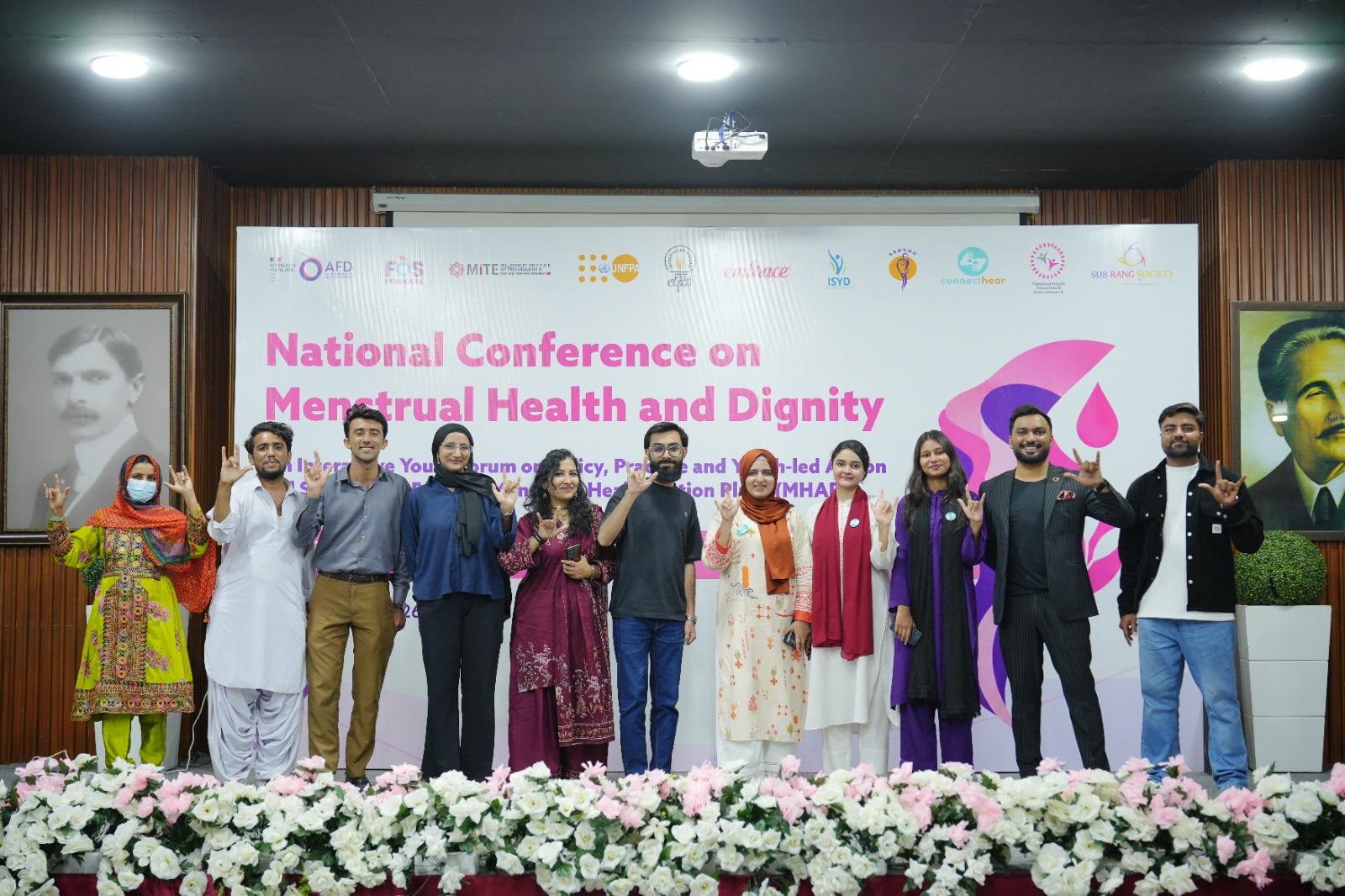
Pakistan convened its first-ever National Conference on Menstrual Health and Dignity in Karachi, bringing together policymakers, health professionals, civil society representatives, youth advocates and development sector leaders to address menstrual health as a public health and human rights issue.
Idara-e-Taleem-o-Aagahi (ITA), Aahung, the Institute for Social and Youth Development (ISYD) and the Menstrual Health Advocacy and Action Network (MHAAN), in collaboration with UNFPA, Embrace, ConnectHear, MiTE and Sub Rang Society, organised the landmark event at the Millennium Institute of Technology and Entrepreneurship (MiTE).
Held under the theme “From Awareness to Action: Advancing Menstrual Health, Dignity and Justice,” the conference attracted more than 150 participants. Funded by Fòs Feminista and the Agence Française de Développement (AFD), the event also marked the seventh Interactive Youth Forum on Policy, Practice and Youth-led Action.
Experts Call for Stronger Policies and Institutional Support
The first panel, titled “Leadership Perspectives on Menstrual Health as a Public Health and Rights Issue,” explored the policy, institutional and rights-based dimensions of menstrual health.
Partnerships Across Maritime Regions AMAN and Pakistan’s Vision for Maritime Peace
Panelists included Marvi Awan, CEO of WPCS and member of SCSW; Annam Khurram Khan, Project Lead at Aahung; Taiba Akhlaq, Brand Manager at Embrace; Aradhiya Khan, Communication Manager at Gender Interactive Alliance; and Aliya Afzal, Lead Sign Language Trainer and Interpreter at ConnectHear.
Public health expert Dr. Talib Lashari called for the integration of menstrual health into public health frameworks. He also stressed the need for national guidelines and a dedicated committee on menstrual health management.
Fawad Shamim, General Manager of Programs and New Business Development at Greenstar Social Marketing, highlighted the private sector’s role in driving social change and improving access to menstrual health products and services across Pakistan.
Youth Advocates Share Community-Based Initiatives
The second panel, “Our Bodies, Our Rights — Youth Champions in Action,” featured young advocates, Period Pride Fellows and community leaders who discussed grassroots interventions, peer education and their experiences of challenging menstrual stigma.
The panel included Abeer Mian, Assistant Professor of Community Health Sciences at Aga Khan University; Muhammad Yousuf, Period Pride Fellow for Punjab at ITA, who leads Humraahi and serves as District Coordinator of Y-PEER Pakistan; Hasrat Ul Nisa, Period Pride Fellow for Sindh at ITA; Amir Ali, Youth Health Educator at Aahung; and Murk Khooharo, Trainer and Social Activist.
Period Pride Fellows also presented their Menstrual Health Action Plans (MHAPs), highlighting initiatives designed and implemented by young people in communities across Pakistan.
A storytelling session by Period Pride Fellow Zarmeen Kausar and a live musical performance by members of Azad Band added creative perspectives to the event. Both presentations reinforced the importance of treating menstrual health as a matter of dignity, rights and collective responsibility.
Sindh Representatives Reaffirm Support
Guests of Honour Dr. Fouzia Hameed, Member of the Provincial Assembly of Sindh, and Shamim Mumtaz, former Sindh Minister for Social Welfare, expressed support for efforts to advance menstrual health and dignity.
They appreciated the organisers for establishing a platform that connects policy discussions with practical initiatives and youth participation.
MiTE Rector Prof. Dr. Huma Baqai also praised the conference and reaffirmed the institution’s commitment to promoting social justice and youth empowerment. She stressed that ending period poverty and challenging long-standing taboos surrounding menstruation must become national priorities.
Organisers Call for Sustained Collective Action
In his closing remarks, Joshua Dilawar, Programme Manager at ITA, thanked the partner organisations, including Aahung, ISYD, Embrace, UNFPA, MHAAN, ConnectHear and Sub Rang Society.
He also acknowledged the support of the Government of Sindh, MiTE, Fòs Feminista and AFD in making the conference possible.
Dilawar urged stakeholders to build on the momentum generated by the gathering and translate awareness into sustained, coordinated action to improve menstrual health and dignity across Pakistan.