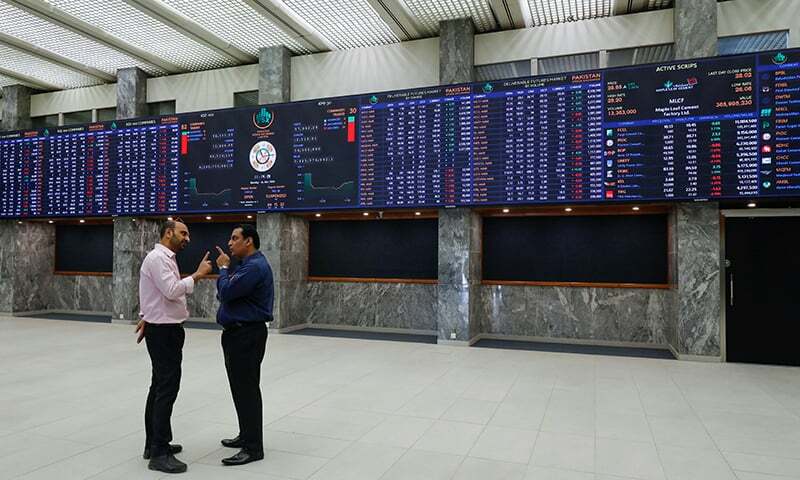
The Pakistan Stock Exchange (PSX) recorded its fourth consecutive weekly decline as domestic political uncertainty, geopolitical tensions and concerns over inflation and a possible interest rate hike weighed on investor sentiment.
The benchmark KSE-100 index fell 0.4% week-on-week, shedding 670 points to close at 166,419, according to Arif Habib Ltd (AHL).
Elevated crude oil prices amid US-Iran tensions and expectations of monetary tightening by the State Bank of Pakistan (SBP) ahead of its upcoming monetary policy meeting added to the pressure.
AKD Securities Ltd said the index suffered its steepest sell-off on Monday, losing 1,965 points following the imposition of emergency and governor’s rule in PTI-governed Khyber Pakhtunkhwa. The market later recovered some losses as initial selling pressure eased.
Oil Prices and Regional Tensions Weigh on Stocks
Brent crude rose to $107 per barrel during the week amid disruptions to energy supplies through the Strait of Hormuz and renewed attacks on Saudi energy infrastructure.
Foreign Investment in Pakistan’s Government Bonds Reaches $188 Million in Early October
The increase came despite the International Energy Agency’s announcement of additional releases from emergency oil reserves.
Higher oil prices raised concerns about imported inflation and the potential impact on Pakistan’s external account. Investors also remained cautious ahead of the SBP’s monetary policy decision.
Energy and Banking Stocks Lead Declines
Exploration and production companies were the biggest drag on the KSE-100, contributing 330 points to its decline. Banks followed with 319 points, while cement companies shed 136 points. Investment banks and power companies contributed further losses of 109 and 76 points, respectively.
Among individual stocks, Oil and Gas Development Company led the decline, subtracting 161 points. United Bank Limited followed with 136 points, while Habib Bank and Pakistan Telecommunication Company each contributed 111 points. Pakistan Oilfields reduced the index by another 95 points.
Fertiliser stocks provided the strongest support, adding 171 points. Oil marketing companies contributed 63 points, refineries 60 points, pharmaceuticals 41 points and fast-moving consumer goods companies 22 points.
Fauji Fertiliser Company was the leading individual contributor on the positive side, adding 85 points. Systems Ltd contributed 81 points, followed by Pakistan State Oil with 62 points, Engro Fertilisers with 60 points and Attock Refinery Ltd with 44 points.
Average daily trading volume increased 5.2% to 449 million shares. However, the average value of shares traded fell 1.5% to $65 million.
Current Account Deficit Widens
Economic data released during the week highlighted continued pressure on Pakistan’s external accounts.
The current account deficit widened to $356 million in September, compared with $73 million in August and a surplus of $123 million in September last year, according to AKD Securities.
The cumulative deficit for the first quarter of fiscal year 2026–27 reached $874 million, up from $755 million in the corresponding period a year earlier.
Pakistan’s trade deficit increased 5% year-on-year and 7% month-on-month to $3.53 billion in September. Exports rose 18% to $2.96 billion, while imports increased 11% to $6.49 billion.
For the first quarter, the trade gap widened 15% to $10.77 billion, with exports reaching $8.45 billion and imports standing at $19.21 billion.
Worker remittances offered some support, rising 13% year-on-year to $3.6 billion in September.
Meanwhile, the SBP’s foreign exchange reserves increased by $16 million to $21.47 billion as of October 9.
Government Debt Auction Exceeds Target
The government raised Rs685.5 billion through a Treasury bill auction, exceeding its target of Rs550 billion.
The three-month tenor attracted the largest amount, at Rs310.1 billion. Yields moved in different directions across maturities.
The auction results came as investors assessed the outlook for interest rates and the government’s domestic borrowing requirements.
Mixed Signals From Industry and Auto Sales
Pakistan’s automobile market recorded a monthly and annual decline in September. Sales of cars, light commercial vehicles, vans and jeeps fell 3% month-on-month and 12% year-on-year to 15,104 units, according to the Pakistan Automotive Manufacturers Association.
However, cumulative sales increased 19% to 50,480 units during the first quarter of FY27.
Large-scale manufacturing grew 0.7% year-on-year in August but declined 5% compared with July.
The real effective exchange rate rose to 108.93 in September from 107.92 in August. The rupee appreciated marginally by 0.03% to close at Rs276.91 against the US dollar.
Investor Accounts and Roshan Digital Inflows Grow
Despite the market’s recent decline, AHL reported a record increase in investor participation.
The PSX added 25,280 investor accounts in September, taking the total number of unique identification numbers to 656,000. That represented an increase of 55% from a year earlier.
Gross inflows under the Roshan Digital Account scheme reached $14.16 billion by September, while net repatriable liabilities stood at $3.07 billion.
Results Season and Oil Prices in Focus
Analysts said geopolitical developments and the September-quarter corporate results season, scheduled to begin the following week, would remain important drivers of market performance.
The KSE-100 was trading at a price-to-earnings ratio of 7.4 times, with a dividend yield of 6.8%.
They noted that improving economic indicators and easing inflation could support investor confidence. A de-escalation in the Middle East could also reduce international oil prices and ease pressure on Pakistan’s external account, potentially lowering the likelihood of further monetary tightening.
However, continued regional tensions, elevated energy costs and uncertainty over interest rates remain key risks for the market.