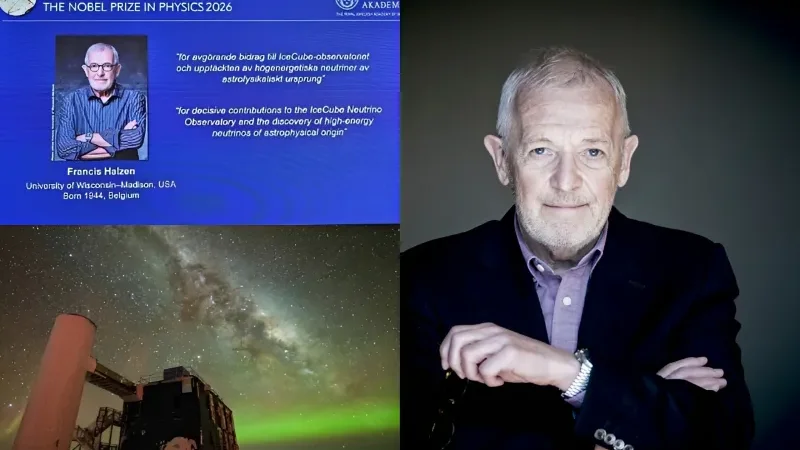
STOCKHOLM: Belgian-American physicist Francis Halzen has won the 2026 Nobel Prize in Physics for pioneering work that transformed Antarctic ice into a giant detector for high-energy neutrinos.
Neutrinos are extremely elusive subatomic particles. They rarely interact with matter and can pass through the Earth and human bodies almost undisturbed.
Halzen realised that the vast volume of ice beneath the South Pole could help scientists detect these particles. His work led to the development of the IceCube Neutrino Observatory in Antarctica.
The observatory uses thousands of sensors embedded deep in Antarctic ice to detect signals produced when neutrinos interact with matter.
New Window Into the Universe
The Nobel committee said IceCube has opened a new way to study the universe. Its observations have helped scientists investigate the origins of high-energy neutrinos and the cosmic events that produce them.
“The messengers bring information from the cosmos,” Eva Olsson of the Royal Swedish Academy of Sciences said at a news conference.
She said neutrinos can provide information about distant galaxies and processes involving exploding stars.
IceCube has detected high-energy neutrinos originating both within and beyond the Milky Way. Scientists hope further observations will reveal more about extreme cosmic events, including phenomena involving black holes and neutron stars.
Halzen first presented his idea for detecting neutrinos at the South Pole in 1988. The IceCube observatory was eventually completed in 2011.
The facility occupies about one cubic kilometre of Antarctic ice and extends to a depth of roughly 2,500 metres. More than 5,000 sensors monitor the ice for neutrino interactions.
FBR Expands AI Use to Scrutinise Individual Tax Returns
‘Neutrino Man’
Halzen became known as “Neutrino Man” because of his pioneering work.
In 2014, Smithsonian magazine honoured him with an Ingenuity Award for the IceCube experiment. The magazine described the project as the beginning of a new era in astronomy.
The Nobel recognition also reflects the contribution of the international team of scientists and engineers who developed the observatory.
IceCube has effectively created a new type of telescope. Instead of observing light, it detects neutrinos that can travel directly from distant cosmic sources.
Because neutrinos carry no electric charge, magnetic fields do not bend their paths. This allows scientists to trace their direction back toward their sources.
IceCube Set for Expansion
The scientific work is expected to continue with IceCube-Gen2, a planned expansion of the observatory.
The upgraded facility is expected to cover about eight cubic kilometres of ice and could detect up to 10 times more neutrinos. Plans call for it to become operational around 2033.
Halzen has said the biggest discoveries from the project may still lie ahead. Scientists expect larger neutrino observatories to provide new information about the universe.
Nobel Prize and Ceremony
The 2026 Nobel Prize in Physics carries an award of 12 million Swedish kronor, worth about $1.2 million.
The Nobel Prizes were established through the will of Swedish inventor and entrepreneur Alfred Nobel. The first awards were presented in 1901.
Past physics laureates include Albert Einstein, Marie Curie, Pierre Curie, Max Planck and Niels Bohr.
The 2025 Nobel Prize in Physics went to John Clarke, Michel H. Devoret and John M. Martinis for experiments demonstrating macroscopic quantum mechanical effects in electrical circuits.
Nobel medals will be presented in Stockholm on December 10, the anniversary of Alfred Nobel’s death. The ceremony will be followed by the traditional Nobel banquet.