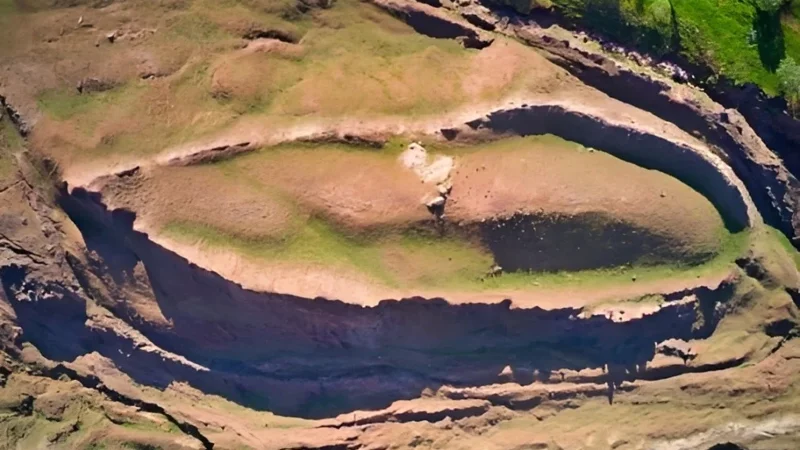
ISTANBUL: An international research team has deployed a custom-built underground robot into the Durupınar formation near Mount Ararat, seeking direct footage of cavities identified beneath the boat-shaped geological structure.
The “Gopher” robot entered an 18-metre borehole after ground-penetrating radar surveys detected underground voids and structures with apparent right-angled features.
The operation was conducted under government permits as part of an ongoing investigation into the geological formation and what lies beneath it.
Designed by Australian roboticists, Gopher carries cameras and is built to navigate narrow underground spaces without requiring extensive excavation. Researchers hope its footage will provide a closer look at the mapped cavities.
The initial deployment faced technical challenges. Loose sediment on the floors of the underground spaces made movement difficult, prompting engineers to modify the robot’s mobility system.
The team has also recovered core samples from depths of up to 18 metres. Researchers said initial observations showed organic material in some sections and no solid bedrock in the areas examined.
Saudi, Pakistan and Türkiye Agree to Deepen Military Cooperation Under Makkah Pact
Soil and timber-like material recovered from the site have been sent to university laboratories for carbon dating and mineral analysis. The tests are expected to help determine the age and composition of the samples and provide additional information about the underground structures.
The Durupınar formation has attracted speculation for decades because of its distinctive boat-like shape and its location near Mount Ararat, which is traditionally associated with accounts of Noah’s Ark.
Noah’s Ark Scans, an independent biblical archaeology and research group led by American researcher Andrew Jones, has promoted the latest investigation and described the robot deployment as a first look inside the underground site.
However, claims that the Durupınar formation is the remains of Noah’s Ark have not been established as scientific fact. Researchers will need further fieldwork, laboratory testing and independent scientific assessment to determine the origin of the underground features and recovered materials.
The investigation is expected to continue as engineers improve the robot’s ability to navigate the cavities and scientists analyze the samples collected beneath the formation.