HANGZHOU: Alibaba has unveiled a new artificial intelligence chip and announced plans for significantly larger AI models, highlighting China’s push to strengthen its domestic technology capabilities as competition with the United States intensifies.
At its annual technology conference in Hangzhou on Tuesday, Alibaba introduced the Zhenwu V900 chip. CEO Eddie Wu described it as “the most powerful AI chip in China today,” saying it delivers three times the performance of the company’s previous Zhenwu M890 chip.
The announcement comes ahead of a planned meeting between Chinese President Xi Jinping and U.S. President Donald Trump, where technology competition, trade and tariffs are expected to feature prominently.
Alibaba said its Zhenwu chips support both the training of advanced AI models and inference, the computing process used by trained AI systems to generate responses. The chips operate in Alibaba’s data centers and provide computing resources for the company and its cloud-computing customers.
The company also outlined plans to develop a new AI model containing between five trillion and 10 trillion parameters. Parameters are variables that AI models use to learn patterns from training data and are commonly used as one measure of model scale.
Alibaba’s current flagship Qwen3.8-Max model has 2.4 trillion parameters, according to the company. Chinese AI rival Moonshot has said its Kimi K3 model, released in July, contains 2.8 trillion parameters.
Alibaba also plans to expand the data-center infrastructure supporting its cloud business as demand for AI computing continues to rise. The company said it aims to control more than 20 gigawatts of computing capacity by 2032.
The expansion comes as Chinese technology companies seek greater self-reliance in AI development while U.S.-led export restrictions limit China’s access to some advanced semiconductor technology and chipmaking equipment.
Recent advances by Chinese AI companies have drawn attention in the United States. Some analysts say the progress could strengthen Beijing’s position in negotiations with Washington, while Chinese developers have increasingly promoted open-source models that can be cheaper to deploy than some leading proprietary systems.
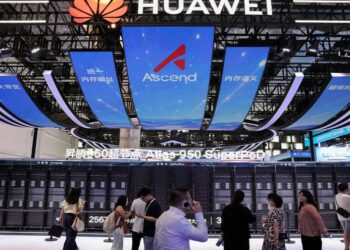
Huawei, another major Chinese technology company, also unveiled new chip technology last week as it seeks to compete with global semiconductor companies such as Nvidia.
Wu said Alibaba was “mobilizing every resource” to meet growing customer demand for AI services. However, he acknowledged that shortages across the global AI data-center supply chain were limiting how quickly the company could expand its computing infrastructure.
The Alibaba CEO also compared the development of AI with the Industrial Revolution and predicted that machine intelligence could eventually surpass human cognitive capacity by a substantial margin.
Wu said machine intelligence is not currently a substitute for human intelligence but forecast that machines could eventually generate more than 1,000 times the collective “thinking” output of humanity. He estimated current machine output at less than 3% of that level.
The latest announcements underline Alibaba’s ambitions to expand its role across China’s AI ecosystem, from semiconductor hardware and cloud infrastructure to large-scale AI models.