Syrian Foreign Minister Asaad Hassan al-Shaibani has proposed a Pakistan-Syria trade council to strengthen direct links between businesses in the two countries.
Al-Shaibani made the proposal during talks with Pakistan’s Commerce Minister Jam Kamal Khan.
The two ministers discussed ways to expand bilateral trade and investment.
The Syrian minister led a high-level business delegation during his visit to Pakistan.
Business council and investment forum proposed
Al-Shaibani proposed establishing a Pakistan-Syria Joint Business Council.
The council would help business communities from both countries develop direct contacts and identify investment opportunities.
UAE Concerts Christina Aguilera and Shakira Events Cancelled Amid Regional War
He also proposed a joint investment forum in Damascus.
The forum would bring together representatives from Pakistan and Syria’s public and private sectors.
Al-Shaibani said current bilateral trade does not reflect the economic potential of the two countries.
He called for sustained engagement between government institutions and businesses.
A Syrian delegation from the Ministry of Economy will also visit Pakistan to explore potential areas of cooperation.
Key sectors identified
The Syrian foreign minister identified several sectors for expanded cooperation.
These include housing, real estate, energy and transportation.
He also highlighted seaports, agriculture, industry and human resource development.
Jam Kamal called for closer coordination between trade authorities in both countries.
He suggested that officials identify priority sectors and develop a practical roadmap for cooperation.
The minister also proposed virtual meetings between Pakistani and Syrian companies.
These meetings could help businesses establish contacts before arranging in-person meetings.
Pakistan seeks stronger institutional ties
Jam Kamal also proposed reviving the Pakistan-Syria Joint Ministerial Commission.
He said the commission and its working groups could provide a formal structure for expanding cooperation.
The minister also called for regular engagement between chambers of commerce in the two countries.
He proposed business delegations and direct business-to-business meetings to strengthen commercial links.
Shehbaz Sharif calls for broader cooperation
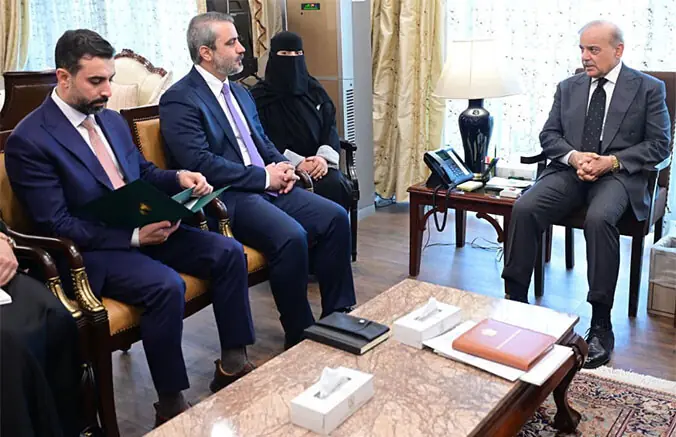
Al-Shaibani also met Prime Minister Shehbaz Sharif.
The prime minister said Pakistan wanted to turn its longstanding friendship with Syria into stronger cooperation.
He highlighted politics, defence, trade, investment, education and human resource development as key areas.
Shehbaz also welcomed the resumption of direct flights between Pakistan and Syria.
He said direct flights would strengthen people-to-people contacts.
They would also facilitate Pakistani pilgrims travelling to Syria for religious visits.
The prime minister reaffirmed Pakistan’s support for Syria’s unity, sovereignty and territorial integrity.
He also pledged support for Syria’s position on the Golan Heights.
Shehbaz invited Syrian President Ahmed al-Sharaa to visit Pakistan at a mutually convenient time.
Pakistan and Syria discuss regional issues
Foreign Minister Ishaq Dar separately held delegation-level talks with Al-Shaibani.
The two ministers reaffirmed the longstanding ties between Pakistan and Syria.
They agreed to strengthen cooperation in areas of mutual interest.
The discussions also covered regional and international developments.
These included Palestine, the Golan Heights, Afghanistan, South Asia and the wider Middle East.
Pakistan, South Korea conclude CEPA talks
Meanwhile, Commerce Minister Jam Kamal said Pakistan and South Korea had completed the first round of negotiations on a Comprehensive Economic Partnership Agreement.
He made the announcement while addressing the Pakistan-Korea Trade and Investment Conference in Seoul.
Kamal said the two sides expected to hold the second round of negotiations soon.
More than 170 Pakistani and South Korean entrepreneurs attended the conference.
Companies from the two countries also signed six memoranda of understanding.
A second Pakistan-Korea trade conference is scheduled for Seoul in March 2027.
The event will build on the business momentum as negotiations on the CEPA continue.