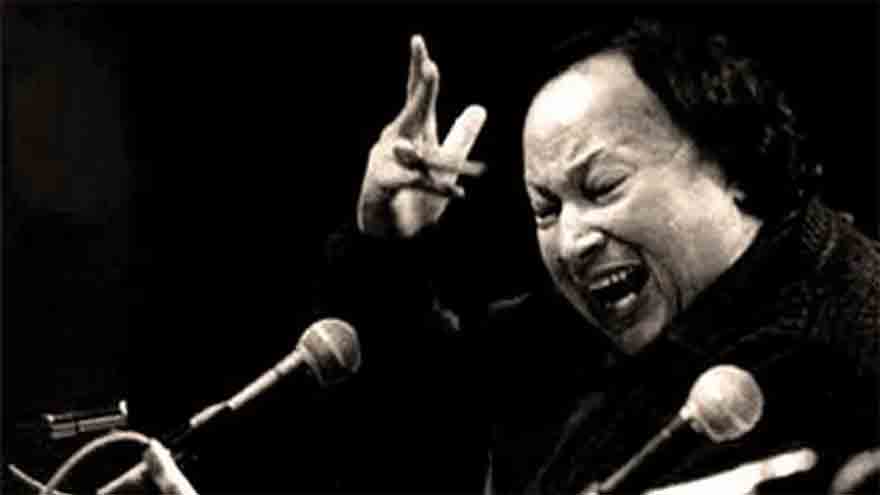
Nusrat Fateh Ali Khan is being remembered today as Pakistan observes the 29th death anniversary of the legendary Qawwali singer, whose powerful voice helped take Sufi music to audiences around the world.
Born on October 13, 1948, in Faisalabad, Nusrat was the fifth child and first son of renowned musician Fateh Ali Khan. He grew up in a family with a Qawwali tradition spanning around 600 years.
Nusrat became one of the most celebrated Qawwali singers in history. His extraordinary six-octave vocal range allowed him to perform with remarkable intensity for several hours.
He became widely known as Shahenshah-e-Qawwali, or the “King of Kings of Qawwali”. His work played a major role in introducing South Asian Sufi music to international audiences.
Nimra Khan UK-Based Pilot Zain Hamid Confirms Divorce From Pakistani Actor
Global recognition
Nusrat’s influence extended far beyond Pakistan. He worked with several international and Indian artists during his career.
His collaborations included Indian composer A R Rahman and lyricist Javed Akhtar. He also reached Western audiences through his collaboration with British musician Peter Gabriel on the soundtrack for The Last Temptation of Christ.
The renowned US magazine Rolling Stone included Nusrat among its list of the “200 Greatest Singers of All Time.” The publication recognised artists who had shaped music history and created lasting connections with their listeners.
Nusrat also earned recognition from the Guinness World Records. According to the record book, he held the record for the largest recorded output by a Qawwali artist, with 125 albums recorded by 2001.
A lasting musical legacy
Nusrat’s music helped bridge cultural and geographical boundaries. His performances introduced traditional Qawwali to new generations and audiences unfamiliar with the centuries-old musical form.
His distinctive voice, improvisational style and powerful spiritual performances established him as one of the most influential Sufi singers of his generation.
Nusrat fell seriously ill with kidney and liver failure in London on August 11, 1997. He died of a sudden cardiac arrest at Cromwell Hospital in London on August 16, 1997.
He was 48.
Nearly three decades after his death, Nusrat Fateh Ali Khan remains an enduring symbol of Pakistani music and one of the most recognisable voices in the history of Qawwali.