Kaja Kallas praises Islamabad’s diplomatic role and highlights trade, climate and security cooperation
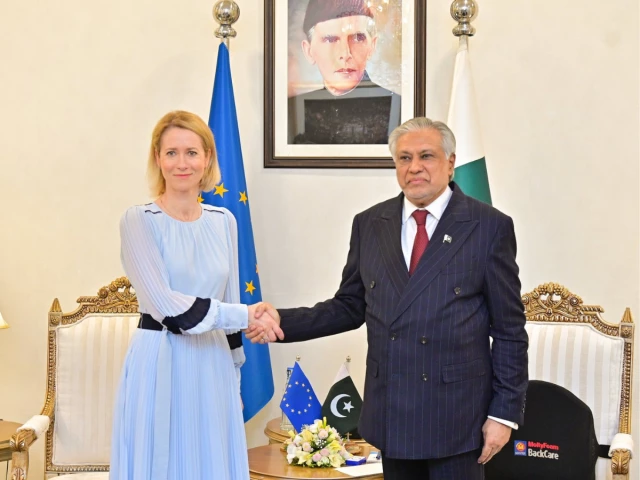
ISLAMABAD — European Union High Representative for Foreign Affairs and Security Policy Kaja Kallas has called for deeper and more forward-looking relations with Pakistan, describing the country as a key regional partner during the 8th Pakistan–EU Strategic Dialogue held in Islamabad.
Speaking alongside Deputy Prime Minister and Foreign Minister Ishaq Dar at a joint press briefing, Kallas said her visit came at a “critical moment” amid shifting global and regional dynamics, with both sides reaffirming their commitment to strengthening cooperation.
Pakistan described as “major regional power”
Kallas said Pakistan plays an important role in regional affairs and stressed the need to expand engagement between the two sides.
“Pakistan is a major regional power and an important partner for the European Union,” she said, adding that the strategic dialogue reflected shared resolve to deepen ties.
She noted that the EU-Pakistan relationship had gained “strong momentum” in recent years, particularly in trade and development cooperation.
Trade ties and GSP+ framework highlighted
The EU official underlined that the European Union remains Pakistan’s largest export destination, stating it is “larger than China and the United States combined.”
She also pointed to Pakistan’s status as the leading beneficiary of the EU’s GSP+ trade scheme, which grants preferential access to European markets.
However, she emphasised that continued benefits depend on Pakistan’s progress in implementing international conventions related to governance, labour rights, environmental protection, and human rights.
Expanding cooperation beyond trade
Kallas said both sides are broadening cooperation into areas including climate resilience, digital infrastructure, clean energy, migration, and mobility.
She also highlighted strong education links, noting Pakistan’s continued top ranking in the EU’s Erasmus Mundus scholarship programme for the fifth consecutive year.
Pakistan’s role in regional diplomacy acknowledged
The EU foreign policy chief praised Pakistan’s diplomatic engagement in global conflicts, particularly its role in facilitating US–Iran contacts.
“Pakistan has been the main mediator between the United States and Iran,” she said, adding that such efforts had helped prevent further escalation in the Middle East.
She also said there was a “tenuous diplomatic opening” regarding the Strait of Hormuz and urged broader negotiations for long-term stability in the region.
Security concerns and regional tensions
Kallas also addressed security issues in South Asia, referring to tensions between Pakistan and Afghanistan and warning of their humanitarian and stability impacts.
She acknowledged Pakistan’s right to self-defence under international law while urging restraint and de-escalation from all sides.
EU ready to support long-term solutions
She said the European Union is prepared to contribute to long-term regional stability through its economic influence, nuclear expertise, and diplomatic engagement across the Gulf and Iran.
Ishaq Dar calls for stronger partnership
In his remarks, Foreign Minister Ishaq Dar called for deeper and more structured engagement between Pakistan and the EU, describing the relationship as one based on “candour and trust.”
He said EU–Pakistan trade stands at around €12 billion and described cooperation under the GSP+ framework as a “win-win arrangement” that benefits both sides.
Dar also highlighted discussions on expanding investment, including follow-up to the Pakistan–EU Business Forum held earlier this year.
Regional issues and security concerns raised
The foreign minister said both sides exchanged views on conflicts in the Middle East, South Asia, Afghanistan and Europe.
He reiterated Pakistan’s concerns over regional security threats, including militant activity originating from Afghan territory, and referred to what he described as “unprovoked aggression” from India.
Dar also reiterated Pakistan’s stance on Kashmir, calling for a resolution in line with UN Security Council resolutions and the wishes of the Kashmiri people.
Commitment to continued engagement
Both sides expressed satisfaction with the pace of bilateral engagement and agreed to maintain regular strategic dialogues.
Kallas said the next phase of relations should place EU–Pakistan ties on a “more forward-looking footing” in 2026, while Dar described the visit as a “significant milestone” in strengthening long-term cooperation.
Growing strategic importance of ties
The European Union remains Pakistan’s second-largest trading partner, with GSP+ status playing a key role in boosting exports, particularly in the textile sector.
Officials from both sides said the dialogue reflects an ongoing effort to transform relations into a broader strategic and economic partnership.