APP
Islamabad: Pakistan and Kazakhstan on Wednesday agreed to significantly expand bilateral trade and investment ties, setting an ambitious target of increasing trade volume to $1 billion and establishing a joint working committee to prepare a five-year roadmap for economic cooperation.
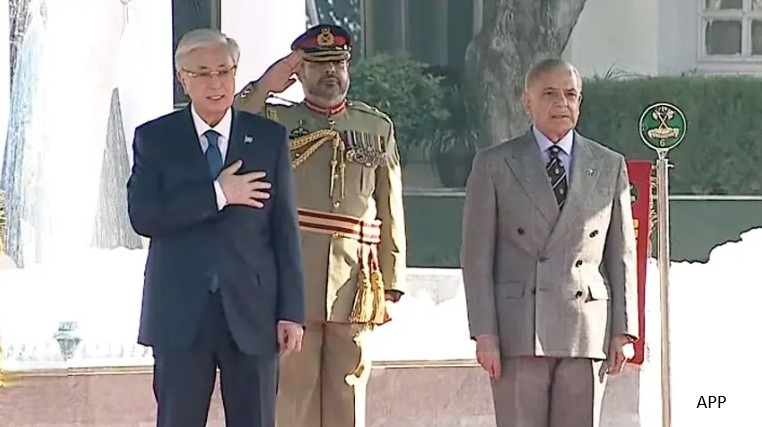
The understanding was reached during delegation-level talks between Prime Minister Shehbaz Sharif and visiting Kazakh President Kassym-Jomart Tokayev at the Prime Minister’s House, where the visiting leader was accorded a formal guard of honour at the start of his two-day state visit.
Both sides described the visit — the first by a Kazakh president to Pakistan in over two decades — as a milestone in relations between the two countries.
Trade and economic cooperation
Prime Minister Shehbaz said existing trade, estimated at around $250 million, did not reflect the true potential of the partnership. He stressed stronger private-sector engagement and joint ventures to boost commerce and investment.
The two sides agreed to form a working committee of senior ministers and officials to devise a structured plan for expanding trade and economic cooperation over the next five years.
A Pakistan–Kazakhstan Business Forum was also welcomed as a step toward increasing business-to-business contacts.

37 agreements and strategic partnership
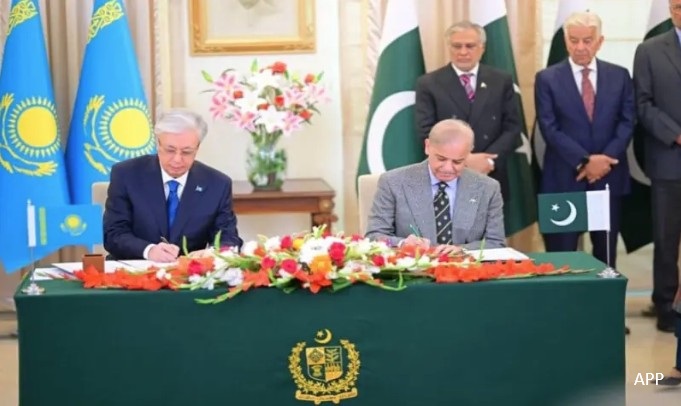
During the visit, the two countries signed 37 memorandums of understanding (MoUs) and agreements covering trade, energy, petroleum, transit trade, customs cooperation, railways, digital development, artificial intelligence, health, education, agriculture, climate change, media, culture and security cooperation.
A Joint Declaration on the Establishment of a Strategic Partnership was also signed, elevating ties to a new institutional level.
Key agreements included a Transit Trade Agreement, customs cooperation pact, extradition treaty, railway and maritime cooperation, banking collaboration between central financial regulators, and partnerships between universities and research institutions.
Connectivity and regional integration
Both leaders emphasized improving regional connectivity through road, rail, air and maritime links, including multi-country transport corridors connecting Central and South Asia.
President Tokayev highlighted Pakistan’s ports, particularly Karachi and Gwadar, as potential gateways for Central Asian trade, while discussions also covered restoring direct flights to facilitate business and tourism.

Energy, education and people-to-people ties
The talks also covered cooperation in energy, mining, agriculture, defence, education and cultural exchanges.
Commemorative plaques were unveiled for a Kazakhstan–Pakistan Dostik Sports Centre and new research and academic centres to promote institutional collaboration.
Leadership engagements
Separately, President Tokayev met President Asif Ali Zardari at Aiwan-e-Sadr, where both sides reaffirmed commitments to regional peace, connectivity and sustainable development.
Later, the Kazakh president was conferred Pakistan’s highest civilian award, the Nishan-e-Pakistan, in recognition of his role in strengthening bilateral ties.
Thanking Pakistan for the warm hospitality, President Tokayev invited Prime Minister Shehbaz Sharif to visit Kazakhstan later this year.
Both leaders expressed confidence that the new agreements would translate into practical projects and open “a new chapter” in Pakistan–Kazakhstan relations.
If you want, I can next condense this further into a shorter 350–400 word version for web publishing or create separate stories (trade / MoUs / ceremony) depending on your outlet’s style.