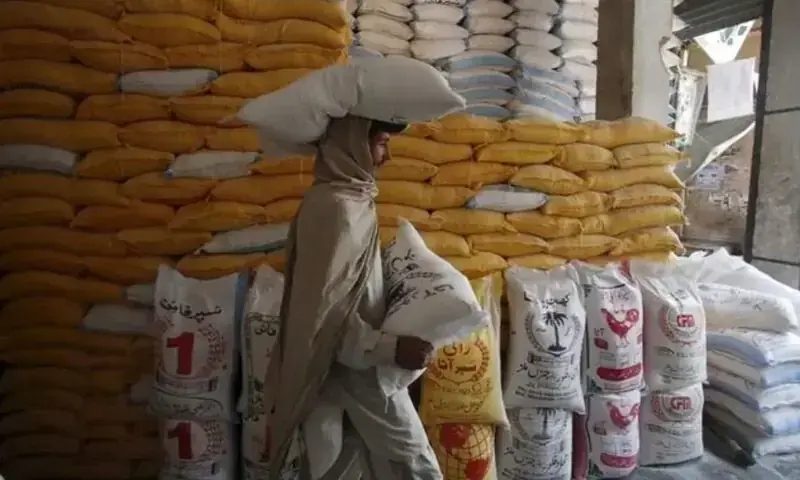
The arrival of imported wheat has failed to ease pressure on consumers, with wheat and flour prices continuing to rise amid concerns over a persistent supply shortage.
Retailers have increased the prices of flour No. 2.5 and fine flour by Rs10 per kilogram, taking their rates to Rs180 and Rs200, respectively. They attributed the increase to higher prices charged by flour millers.
More than 100,000 tonnes of imported wheat have arrived in Pakistan since the last week of October. Following the arrival of the first shipment carrying 51,000 tonnes on October 28, wheat prices initially fell from Rs140 to Rs130 per kilogram.
However, prices in the open market returned to Rs140 per kilogram last week, prompting millers to increase the rates of various flour products.
Cereal Association of Pakistan (CAP) Chairman Muzammil Chappal told Dawn that he had been warning the government since May about a possible wheat shortage of four million tonnes. He said he had also urged authorities to allow the private sector to import at least two million tonnes of wheat, but the government had not responded to his proposals.
Stakeholders warn of a 3–4 million-tonne shortage
Pakistan recorded a 4.3 per cent increase in wheat production in FY26, with output reaching 29.61 million tonnes compared with 28.40 million tonnes in the previous year, according to the Economic Survey FY26.
Asim Azhar Sparks Wedding Rumours After Viral Groom Look
However, Chappal said annual wheat demand stood between 31 million and 32 million tonnes. He added that rising demand, driven partly by annual population growth of more than three per cent, was increasing pressure on supplies.
Wholesaler and trader Rauf Ibrahim estimated that Pakistan needed at least three million tonnes of additional wheat before the next crop from Sindh and Punjab entered the markets between March and May next year.
He also criticised federal and provincial authorities for failing to take effective action against hoarding and the unauthorised movement of wheat stocks. Ibrahim urged the government to inspect commodity stocks in markets and warehouses, warning that speculators and investors were influencing the market.
According to Ibrahim, millers had increased the prices of flour No. 2.5, maida and fine flour in 50kg bags to Rs8,100, Rs9,000 and Rs9,150, respectively, from Rs7,800, Rs8,400 and Rs8,550.
High-quality chakki flour is selling for Rs200 per kilogram in the wholesale market, while retailers are charging up to Rs215.
Millers had previously raised flour prices by Rs20 per kilogram but reduced them ahead of the arrival of imported wheat. Prices have started climbing again, with traders pointing to a lack of effective government monitoring.
Ibrahim said Karachi’s wheat market was also under pressure because Sindh was waiting for imported supplies, while the arrival of grain from Punjab had stopped, leaving local millers short of wheat.
A miller, who requested anonymity, said the situation was alarming because wheat prices had also increased in Punjab and Khyber Pakhtunkhwa despite the arrival of imported grain.
He added that flour prices were not uniform across the milling industry, as individual mills were setting rates according to their wheat stocks and prevailing market conditions.
Imported wheat may prove insufficient
The miller warned that imported wheat would not be enough to meet demand. He said Karachi’s flour mills alone required around 80,000 bags of 100kg wheat every day for grinding.
Ibrahim said federal and provincial governments had yet to take adequate measures to address the shortage, which was placing a heavy burden on low- and middle-income households.
He warned that consumers could face the prospect of paying Rs2,000 for a 10kg flour bag. He also called for inspections of flour millers’ stocks, noting that mills generally maintain one to two months’ worth of grain supplies.
Meanwhile, tandoor owners are facing pressure from rising flour and liquefied petroleum gas (LPG) prices.
Despite higher costs, they have so far kept the prices of chapati, naan, sheermal and taftaan, and qulcha unchanged at Rs20, Rs30–35, Rs100–110 and Rs90–100, respectively.