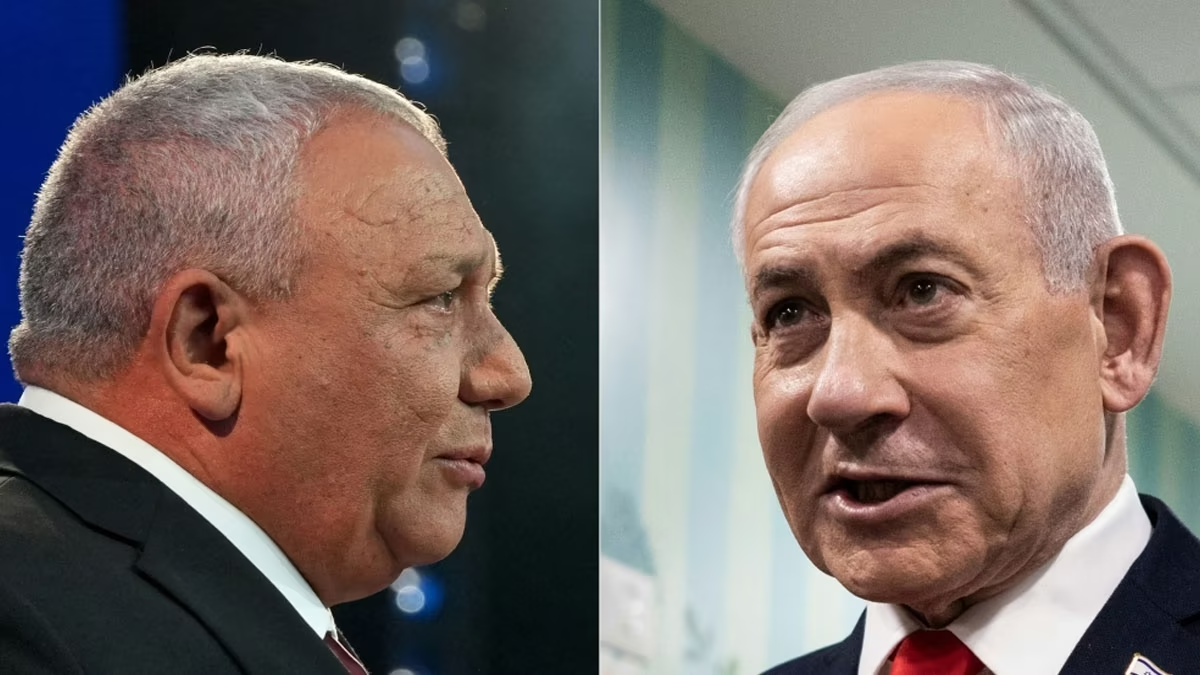
Israel’s caretaker Prime Minister Benjamin Netanyahu on Saturday renewed his call for a national unity government with political rival Gadi Eisenkot, who dismissed the proposal as a political tactic.
The latest exchange comes as Eisenkot negotiates to form a new government after being tasked with the process on Sunday.
In a video statement, Netanyahu said a meeting with Eisenkot on Thursday had strengthened his belief that a national unity government was necessary to safeguard Israel’s security.
He argued that such a government could “eliminate the Iranian threat once and for all” and said it should include parties that recognise Israel as a state for the Jewish people.
Netanyahu also warned against Eisenkot’s proposal to establish a minority administration under the title of a “national emergency government”.
Saudi Coalition Intercepts Houthi Missiles and Drones Targeting Kingdom
Under the proposed arrangement, the 48 lawmakers in Eisenkot’s bloc would support the government, compared with 46 legislators backing Netanyahu. The remaining 26 members of the 120-seat Knesset, representing Arab and ultra-Orthodox parties, could abstain, potentially allowing the government to secure approval without an absolute majority.
Eisenkot accuses Netanyahu of political manoeuvring
Responding shortly afterwards, Eisenkot said Netanyahu knew he had lost the election and accused him of using the unity proposal to delay or disrupt government formation.
“Netanyahu is calling for negotiations while they are already underway; he claims to want unity but… sows division and stokes tensions as if there were no tomorrow,” Eisenkot said.
He added that Netanyahu’s political tactics would not influence him.
Eisenkot calls for break with far-right factions
Eisenkot was given 28 days to form a government, with a possible 14-day extension. The negotiations are expected to be difficult, particularly amid Netanyahu’s campaign against Arab-Israeli parties, which secured a record number of seats in the election.
Netanyahu’s proposed unity arrangement would bring together major Jewish political parties from the centre to the right while excluding Arab parties.
Eisenkot has indicated that he could consider working with members of Netanyahu’s Likud party and outgoing Finance Minister Bezalel Smotrich’s Religious Zionism party, provided their commitment to national unity is genuine.
However, a government that includes Netanyahu himself remains unlikely after Eisenkot criticised what he described as the caretaker premier’s “racist” campaign against Arab parties on Friday.
On Saturday, Eisenkot again called for a “break with the extremists”, particularly supporters of far-right minister Itamar Ben Gvir, as a condition for parties seeking to join his government.
Knesset speakership adds to political tensions
Another dispute centres on Tuesday’s election for speaker of the Knesset, a position currently held by Amir Ohana, a close ally of Netanyahu.
The opposition has nominated Matan Kahana, a former Israeli army officer who ranked fifth on Eisenkot’s electoral list, to replace him.
Eisenkot said parties claiming to support genuine political cooperation should allow the democratic process to proceed and instruct their lawmakers to back Kahana’s appointment.
The dispute over the speakership is adding another challenge to the negotiations as Eisenkot works to assemble a parliamentary majority.