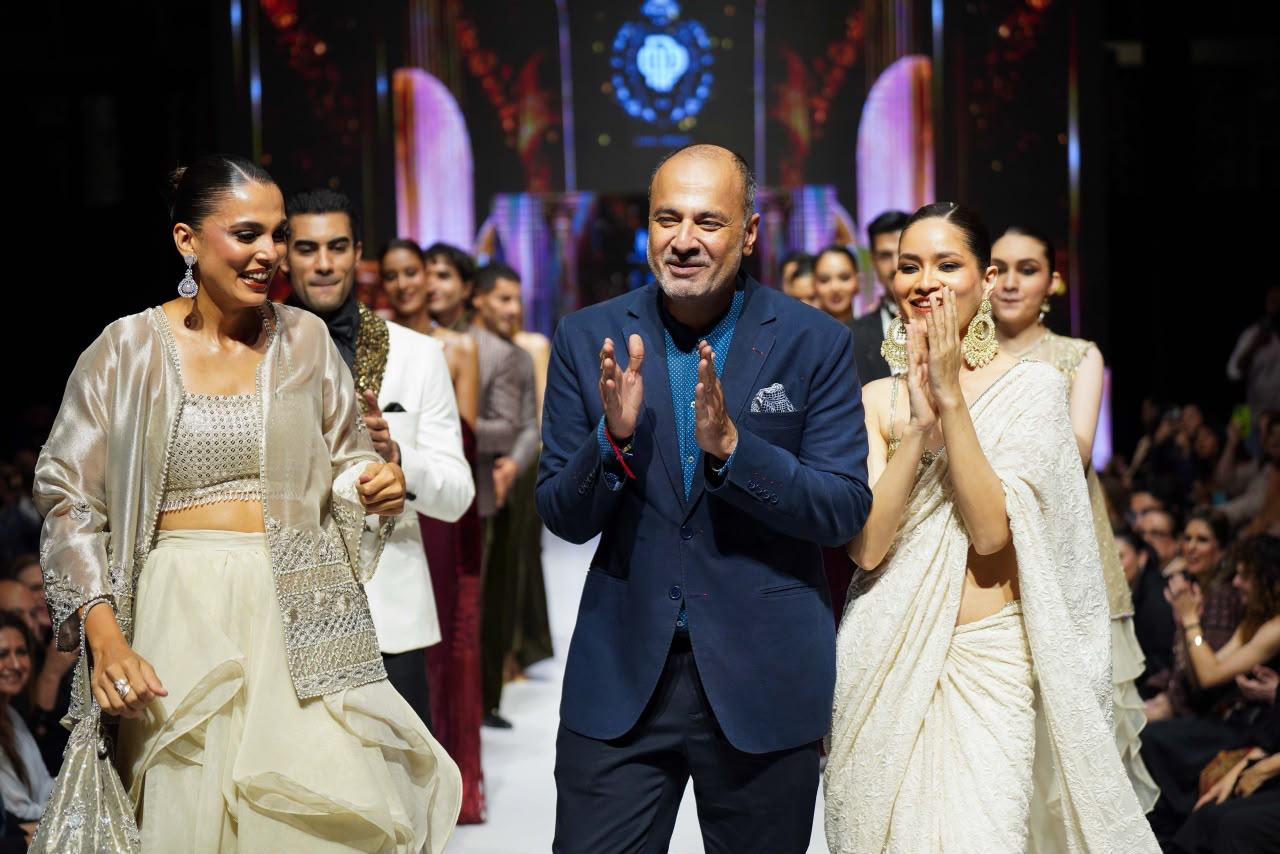
KARACHI, September 26, 2026: LAAM Fashion Week (LFW) concluded the second edition of LFW Presents in Karachi with Kaleidoscopic Karachi, a five-designer runway showcase held at the historic Nusserwanjee Building at the Indus Valley School of Art and Architecture (IVS).
The event marked the first edition of the LFW Presents format outside Lahore and featured collections by Deepak Perwani, Wardha Saleem, Khaadi, The Pink Tree Company and Sana Safinaz. The evening opened with Tapu Javeri – A Four-Decade Fashion Retrospective, showcasing the work of renowned Pakistani fashion photographer Tapu Javeri.
Built around the idea of Karachi as a city of contrasts, Kaleidoscopic Karachi brought together glamour, craftsmanship, heritage and contemporary design. Each presentation offered a different interpretation of the city and its evolving fashion identity.
Sindhi Identity Finds New Expression in the Digital Age
Speaking at the event, Saad Ali, CEO and Founder of Design651 and Co-Founder of LAAM Fashion Week, said the initiative was designed to help build a year-round fashion ecosystem for designers, brands and craftspeople.
He said LFW Presents was created to provide fashion professionals with platforms, settings and audiences beyond traditional runway calendars, adding that bringing the format to Karachi represented an important step in that direction.
The evening began with Tapu Javeri’s four-decade retrospective, which drew from his archive and explored the evolution of Pakistani fashion and Karachi through photography. The exhibition provided a historical context for the runway presentations that followed.
Deepak Perwani opened the runway with Cocktail Hour, a collection inspired by Karachi’s glamour and social life of the mid-1970s. The presentation featured sleek silhouettes, sparkle and glitter, connecting the city’s fashion history with contemporary design. Former supermodels Frieha Altaf, Seemi Pasha and Atiya Khan also walked the collection as a tribute to the era.
Wardha Saleem followed with Bander Road Se Kemari, drawing inspiration from Karachi’s architecture and urban landscape. Colonial buildings, balconies, monuments and architectural details were translated into cuts, prints and drapes. Actress and model Areeba Habib served as the collection’s showstopper, appearing in a gold and green lehenga.
Craft took centre stage with The Pink Tree Company’s Hands That Craft. The collection brought together block printing, dyeing, embroidery, gota, kaamdani and other traditional techniques. Showstopper Aliya Iqbal Naqvi appeared in a colourful lehenga, highlighting the collection’s emphasis on handcrafted fashion.
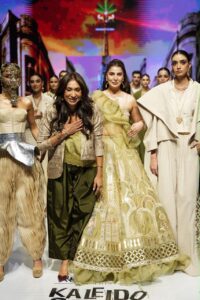
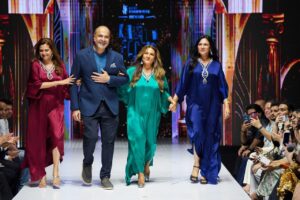
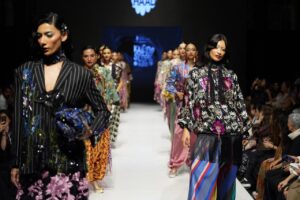
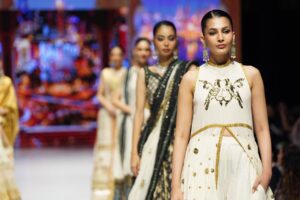
Khaadi presented Karachi – It’s Complicated, exploring the contrasts associated with the city, from chaos and quiet to affection and tension. The collection combined woven fabrics, contrasting colours and bold prints. Model and showstopper Eman Suleman walked in a black-and-white striped top with colourful embellishment, paired with a black skirt featuring pink floral prints.
Maheen Kardar, Executive Director of Designer Experience and Curation at LFW Presents, described Karachi as an important part of Pakistan’s fashion history and said the city’s layered identity was central to the concept of Kaleidoscopic Karachi.
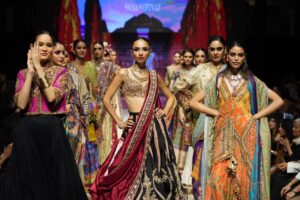
The evening concluded with Sana Safinaz’s Mastaani, a luxury couture and festive collection presented by 20 models. The finale combined traditional heritage with contemporary silhouettes, including fluid drapes, couture lehengas and embellished statement pieces.
Model Javeria Hanif served as the finale’s showstopper, appearing in a heavily embellished gold blouse with a black lehenga, red dupatta and black veil.
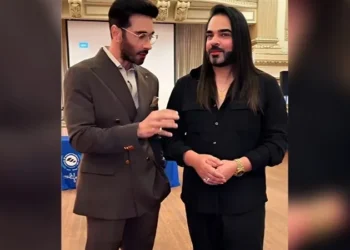
The event also attracted figures from Pakistan’s fashion, entertainment, media and creative industries. Guests included Bunto Kazmi, Faiza Samee, Fahad Mirza, Gohar Rasheed, Iqra Aziz, Kamiar Rokni, Kubra Khan, Nadia Hussain, Parishae Adnan, Saniya Maskatiya, Sarwat Gillani, Shehla Chatoor, Sharmila Faruqui, Sonya Battla, Zainab Chotani and Zainab Qayyum, among others.
Amir Iqbal, Co-Founder and COO of LAAM and Co-Founder of LAAM Fashion Week, said technology, commerce and international logistics were central to the platform’s broader fashion ecosystem. He said LAAM aims to connect Pakistani fashion with consumers and markets beyond the country.
The historic Nusserwanjee Building at IVS provided the setting for the showcase. Originally built in Kharadar and associated with Karachi’s Parsi heritage, the structure was dismantled and reconstructed at the IVS campus, where it now forms part of the institution’s architectural landscape.
Arif Iqbal, Co-Founder and CEO of LAAM and Co-Founder of LAAM Fashion Week, said technology and creative direction could help transform fashion events into global content and commercial platforms.
Kaleidoscopic Karachi brought together different interpretations of the city through fashion, photography, architecture and craftsmanship, presenting Karachi as a place where heritage and contemporary creativity continue to intersect.