
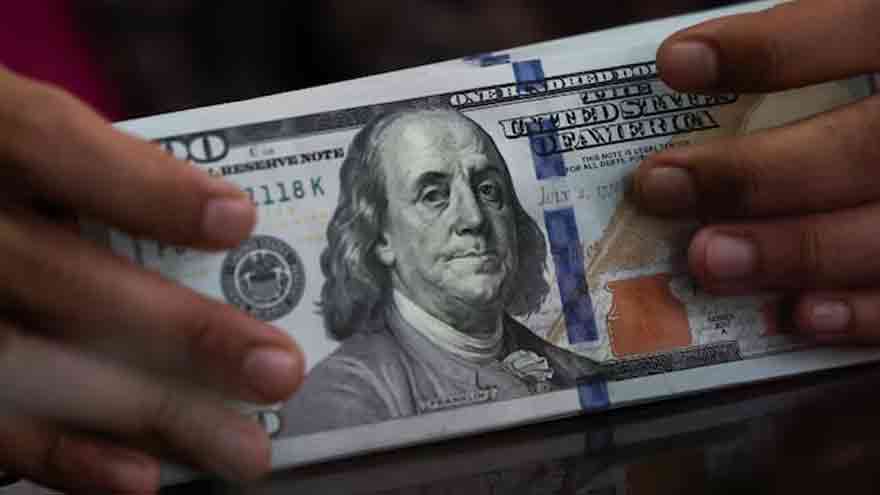
The US dollar edged higher on Tuesday, trading near a two-week high as surging oil prices pushed US Treasury yields higher and reinforced expectations that the Federal Reserve will raise interest rates this week.
The greenback also benefited from weaker risk appetite after global stock markets fell, with artificial intelligence-related shares coming under pressure following calls from industry leaders for slower development to address potential risks.
Markets are now pricing in a roughly 93% probability of a Federal Reserve rate hike on Wednesday, according to CME’s FedWatch tool. Such a move would mark the first increase in more than three years.
Higher oil prices, rising US yields and weaker appetite for risk have provided broad support for the US dollar, according to Christopher Wong, an FX analyst at OCBC.
The dollar index, which measures the greenback against a basket of major currencies, was last at 99.55.
The euro slipped slightly against the dollar to $1.1538, while sterling eased to $1.3494. The Japanese yen also moved away from a seven-month high, falling about 0.2% to 154.72 ahead of an expected Bank of Japan rate hike on Friday.
Oil prices climbed to around $107 a barrel, close to a four-month high, after Iran-aligned Houthi forces in Yemen attacked Saudi Arabia and talks between Iran and Gulf states were postponed.
Petrol, Diesel Prices Rise Sharply Across Pakistan
The rise in oil prices has renewed concerns over inflation and pushed benchmark 10-year US Treasury yields above the key 5% level in the previous session for the first time since October 2023. The yield was last at 4.9895%.
Fresh inflation concerns followed a stronger-than-expected jobs report and an acceleration in consumer prices in August, strengthening expectations for a Federal Reserve rate increase on Wednesday.
Economists surveyed by Reuters also expect at least one additional rate hike by the end of March, reversing the fragile expectation of unchanged policy that prevailed before recent inflation data.
Analysts at BCA said the inflation outlook would increasingly depend on oil prices, while the broader economic picture did not currently justify more rate increases than markets have already priced in.
Markets are also assigning a high probability to a Bank of Japan rate hike on Friday. Sentiment toward the yen has begun to shift, with speculators moving into a net-long position on the currency for the first time since February.
Meanwhile, the New Zealand and Australian dollars were each down about 0.1%, trading at $0.5769 and $0.7133, respectively.
The offshore yuan was little changed at 6.708 per dollar, remaining close to its strongest level in more than three years as investors awaited China’s industrial production and retail sales data.