
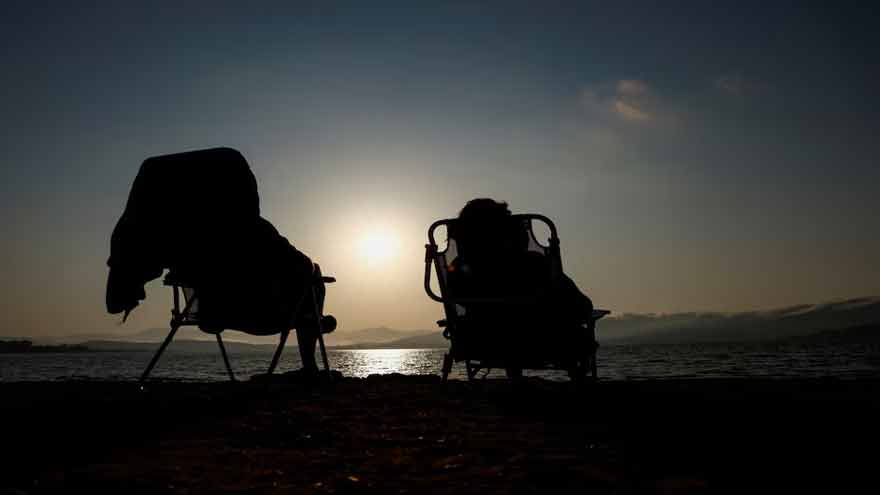
Total Solar Eclipse watchers gathered across Spain and Iceland on Wednesday to witness the rare moment when the Moon passed directly between Earth and the Sun.
Millions of people prepared with protective glasses and travelled to locations along the eclipse’s path. For a brief period, daylight turned into twilight as the Moon blocked the Sun.
The event revived humanity’s longstanding fascination with eclipses. Historically, many cultures viewed the sudden darkness as an omen or a sign of divine power.
Mir Raza Case Taxi Driver Shares Details of Final Ride
Today, however, skywatchers see eclipses as rare scientific and visual experiences.
“I hope that tonight will see the emergence of a wonderful generation of astrophysicists,” Spain’s Secretary of State for Science Juan Cruz said. “It’s such a special moment.”
Spain Prepares for Millions of Visitors
Spanish authorities expected up to 6 million visitors in mostly rural areas along the eclipse path across northern Spain and the Balearic Islands.
The timing made the event particularly attractive. In Spain, the eclipse was expected to occur shortly before sunset.
However, authorities also faced significant safety challenges.
The eclipse coincided with one of Spain’s highest-risk periods for wildfires. As a result, the government deployed a large police operation and launched a public safety campaign.
Officials also viewed the event as an opportunity to promote less-visited regions. In addition, they hoped to ease pressure on heavily crowded coastal destinations by directing visitors inland.
The Iberian Peninsula last experienced a total solar eclipse in 1912. Another total eclipse will cross the region on August 2, 2027, followed by an annular eclipse in January 2028.
Together, the events form what has become known as the “Iberian Eclipse Trio.”
Iceland Braces for Eclipse Crowds
Meanwhile, Iceland prepared for a major influx of visitors.
In the capital, Reykjavik, eclipse glasses had sold out days before the event. Iceland, with a population of roughly 400,000, expected up to 80,000 visitors.
The narrow path of totality was due to reach Iceland’s western coast at about 5:44pm local time, before the Moon’s shadow moved east.
Total darkness was expected to last up to two minutes and 13 seconds in the far west. Most cities, however, would experience shorter periods of totality.
Authorities warned visitors about heavy traffic. They also urged spectators to reach viewing locations early.
The eclipse also attracted entertainment events. Icelandic singer Björk was scheduled to perform a DJ set at an eclipse-themed event south of Reykjavik.
NASA Studies the Eclipse
The eclipse also provided an opportunity for scientific research.
NASA planned to operate a high-altitude WB-57 aircraft from Iceland to follow the Moon’s shadow.
Meanwhile, NASA-funded teams planned to launch balloons to study changes in the lower atmosphere as darkness and temperatures suddenly shifted.
Scientists hope the observations will improve understanding of how the atmosphere responds to rapid changes in sunlight.
Eclipse Chasers Follow the Shadow
The event attracted not only casual viewers but also dedicated “eclipse chasers” who travel around the world to experience total solar eclipses.
Gordon Telepun, a retired plastic surgeon and amateur astronomer from the United States, has photographed six total eclipses.
He planned to watch the event from Mallorca in Spain.
“Spain checked all the boxes for eclipse chasers,” Telepun said, citing favourable August weather prospects, a totality lasting more than one and a half minutes and easy travel access.
For millions of spectators, the eclipse offered a rare chance to witness one of nature’s most dramatic celestial events.